The freedom of healing, part one: Choosing to be healed

Now there is in Jerusalem by the Sheep Gate a pool, in Hebrew called Beth-za'tha, which has five porticoes. In these lay a multitude of invalids, blind, lame, paralyzed. One man was there, who had been ill for thirty-eight years. When Jesus saw him and knew that he had been lying there a long time, he said to him, "Do you want to be healed?" The sick man answered him, "Sir, I have no man to put me into the pool when the water is troubled, and while I am going another steps down before me." Jesus said to him, "Rise, take up your pallet, and walk." And at once the man was healed, and he took up his pallet and walked.
-- John 5:2-9

Last February, I showed up at the doctor’s office with a laundry list of mysterious symptoms. It seemed that the emotional rollercoaster of the past year had finally caught up with me — that the more my life felt like it was falling apart, the more my body followed suit. So when I finally couldn’t take the pain or the uncertainty any longer, I begrudgingly booked an appointment and rode the Hot Mess Express all the way there.

As a public health professional, I would never advise anyone else to wait until they “couldn’t take it anymore” to see a doctor. I’m a huge advocate for prevention and early detection, but alas, I’m also human, and I don’t always practice what I preach. I have a complicated medical history and knew that this appointment would mean sharing my story all over again with a total stranger — a process that would inevitably trigger some not-so-pleasant memories from my childhood and teenage years. So, although I wouldn’t recommend it, I waited until my need for answers was stronger than my desire to avoid rehashing the past. I’m sure many of you can relate.

When my new doctor walked into the exam room and asked what had brought me in that day, I took a deep breath and gave my usual spiel. With each additional detail, I noticed the crease in her brow grow a bit deeper, but she let me continue uninterrupted. When I got to the end and motioned in her general direction as if to say, “Take it away, doc! Diagnose me,” she offered an encouraging smile and began addressing each point in turn. She took the puzzle pieces I had rapidly hurled at her and thoughtfully laid them out, sorted them by color, and fit them neatly into place, and as I sat and watched a coherent picture begin to take shape, I felt a wave of relief wash over me. Maybe this wouldn’t be so bad after all. 

When she got to my anxiety — the last item on the list and the one that had made her brow crease most deeply — I largely brushed her off. By that point, I was feeling encouraged enough about everything else that I felt I could live with the constant worry in the pit of my stomach. After all, I’d dealt with it my whole life, hadn’t I? But she persisted.

“How do you feel on a daily basis?” she asked. “Does your anxiety affect your daily activities?”

“Oh yes,” I replied without missing a beat. “I wake up every morning with a feeling of dread and unease, which steadily increases throughout the day, especially when I’m at work. And occasionally I have panic symptoms. I had been panic attack-free for several years, but lately the symptoms have started creeping back in.” I said all of this matter-of-factly, as if she has merely inquired about the day’s weather.

“And…is that how you want to feel every day?” she asked gently but pointedly.

“I mean…” I paused and let out a defeated sigh. “No, not really.”

She pointed out that my anxiety was likely causing or contributing to the majority of my other issues, especially the throbbing headaches that seemed to crop up almost daily, and she encouraged me to give medication and therapy another try. And although I knew she was right, I still managed to offer a handful of halfhearted excuses — I didn’t have time for therapy, I didn’t want to deal with the side effects of medication, etc. — before finally consenting.

As I left the clinic that day, I was puzzled by my reaction. Personally and professionally, I’m a huge supporter of medication and therapy for managing mental health issues, and I have successfully used both to address my anxiety in the past. So why was I experiencing such hesitation this time? Why was I trying to avoid or delay getting the help I clearly needed?

It wasn’t until the following weekend that I started to unpack my resistance. I was helping out at my church’s high school confirmation retreat, and the theme was healing (because of course it was!). One of the other volunteers gave a talk based on the above passage from the Gospel of John, in which Jesus heals a man who has been paralyzed for 38 years. The volunteer read the passage aloud and encouraged us to reflect on Jesus’ pointed question — “Do you want to be healed?” — and the man’s roundabout response. Why did he make excuses rather than seize the opportunity to walk again? Could it be that he didn’t actually want to be healed, that he was afraid of change, that as much as he loathed being paralyzed, at least it was comfortable and familiar? Or that, after all those years, he no longer believed that healing was even possible

Um, ouch?

I was suddenly very relieved to be sitting in the back of the room, because I could feel my cheeks turning red and my eyes filling with tears as I realized this is exactly what had happened at my doctor’s appointment.

She had essentially posed the same question — “Do you really want to live like this? Or do you want to be healed?” — and I, paralyzed by anxiety, had made excuses. Because if I was being totally honest, I trusted God with a lot of things, but I had essentially stopped even trying to trust him with my health. It was too much of a mess, there was some damage that simply couldn’t be reversed, and anxiety was just going to be my “thing.” It seemed that I was always going to sit just at the edge of the water, so close and yet so far from the healing I wasn’t even sure was possible. But in that moment, I realized I didn’t want to stay there anymore. When Jesus asked if I wanted to be healed, I wanted my answer to be a resounding, “Yes! And I know you can and you will.” So I decided to trust Him, or at least try to trust Him.

When I returned home from the retreat, I started taking my new meds. Two months later, I scheduled my first therapy appointment. Throughout it all, I tried to imagine what it would look like to surrender to God even this area of my life that seemed hopeless and irredeemable. The transformation wasn’t instantaneous, of course — it took weeks to adjust my medication dosage and months to wade through some serious muck with my therapist, and trusting God with my health is still a daily wrestling match. But Y’ALL.

I had all but forgotten that waking up to feelings of intense dread wasn’t normal. I had all but forgotten that my heart wasn’t supposed to constantly pound, my stomach wasn’t supposed to constantly churn, and my head wasn’t supposed to constantly ache. I had all but forgotten that I am capable of dealing with the stresses of life, both big and small — sometimes I just need a little extra support. I can’t believe I almost let myself continue to live like that. Thank goodness for my doctor, who was truly imaging Christ to me that day — reminding me that I was made for more, but that I had to want it and believe it was possible, and take the necessary actions to get there. 

I had just started assuming that anxiety was my cross to bear and therefore I would always buckle under its weight to some extent. And while it’s true that the Lord doesn’t always miraculously erase our physical or mental ailments — more often than not, we end up living with them indefinitely — we can always trust Him with these things and know that He will heal and redeem them in His time. Anxiety may very well be a lifelong battle for me, but that doesn’t mean that the Lord won’t grant immense healing along the way, as He has proven over these past few months. Furthermore, He can use any suffering I experience for good. Already I can see how my anxiety has strengthened my faith and helped me to surrender more fully to His plans. Already I can see how my anxiety has helped me to better love and encourage others with similar struggles. How much more does God surely have in store for my mental health journey.

I was okay with living like a shell of my former self, but the Lord, like my doctor, wanted me to experience the freedom of healing.

The truth about singleness: Trading tired cliches for real talk (From a fellow single gal)

I put the SING in single
Ain't worried 'bout a ring on my finger...
-- Lizzo, "Truth Hurts"

Usually, I start my posts with a scripture passage related to the topic at hand. Often times, it’s the actual verse I was praying with when the idea for the post came about.

Today, I’m starting with a line from a Lizzo song, because that’s what inspired this post. I wasn’t praying at the time, but I sure was jamming in my car.

Let me start by saying that as a single person, I’m tired — not of being single but of the predominant narratives surrounding singleness. Despite the fact that the topic is everywhere — there are no shortage of books, blogs, magazine articles, talks, TV shows, movies, comedy specials, and awkward conversations at family holiday gatherings about it — I have found very few perspectives that truly resonate. I have heard very little advice that is actually helpful and very few reassurances that coincide with reality.

So I’m here — as your friendly neighborhood single gal, a 28-year-old practicing Catholic who is reasonably confident that marriage is her vocation — to drop some truth that may or may not hurt.

But first, let’s start by identifying common responses to singleness that, while typically well-meaning, are NOT helpful — and examine why. Below are a few examples of things people have said to me or my friends when they find out we aren’t presently in a relationship:

“You’ll find someone — just when you’re least expecting it!”

“God has a great guy out there for you, and He will bring him to you when the time is right!”

“You just gotta put yourself out there more! Have you tried [insert obvious strategy for interacting with other humans]?”

“I thought I’d never find someone, either, and then I finally met so-and-so when I was X years old!” (Doubly offensive if X < my current age)

“I can’t believe some great guy hasn’t snatched you up yet!” (See also, “Any guy who wouldn’t want to date you is an idiot!”)

“Enjoy this time of being single! Now that I’m married/have kids, I’d kill for that kind of freedom again.”

“Take advantage of this time of preparation! Use this opportunity to discover who you are, grow in your faith and friendships, etc.”

And the Emmy for Most Horrific Remark in the Comedy That Is My Life goes to…

“You still have time before your eggs get too old!”

Some of these responses are obviously more problematic than others, but all are flawed in at least 2 ways:

  1. Each statement is predicated on the assumption that I will find someone — that it’s not an “if” but a “when.”
  2. Each statement implies that at best, singleness is an uncomfortable step in the journey toward love, and at worst, it’s a problem that needs to be solved, sooner rather than later.

Even the statements that seemingly point to the “benefits” of being single undermine themselves because of the sheer fact that they have to be said at all. When something is widely accepted as good, no one has to make a concerted effort to tout the benefits. This is the same reason I hesitate to eat anything with “Delight” (or worse, “Delite”) in the name. If the tuna were really so terrific, then ya wouldn’t need to say so, would ya?

There’s also the fact that when taken together, all of this well-meaning advice contradicts itself. I’m supposed to put myself out there, but also try not to fixate on meeting someone so it’s “unexpected”? I’m supposed to think guys are idiots for not wanting to date me while simultaneously wanting to date one of these so-called idiots? It’s enough to make one’s head spin.

Instead of all of these tired cliches, my heart longs for someone — anyone — to simply speak the truth. But no one seems willing to say it, perhaps because it initially sounds a little cynical. So, at the risk of playing Debbie Downer, I’ll say it myself:

It is completely possible that I can deeply desire and feel called to marriage and never find a spouse.

I don’t say this because I’m hopeless and have given up on the idea of finding love. I don’t say this because I have low self-esteem and don’t think I’m worth loving or committing to. I don’t say this because I have too little trust in God. I say it because it’s true. And the truth is freeing, even if it hurts a little.

Because it is also true that I can deeply desire and feel called to marriage, never find a spouse, and still live a happy, meaningful life full of love. In fact, if I stay close to the Lord, it’s impossible for my life to be without love. He is Love itself.

This is the kind of abundance that Jesus is referring to when He says in John 10:10: “A thief comes only to steal and slaughter and destroy; I came so that they might have life and have it more abundantly.” I don’t have to wait to start living a great love story. I don’t have to let Snow White’s “Someday My Prince Will Come” be the theme song of my 20’s and 30’s (and beyond) when the King of the Universe already thought I was special enough to die for. I don’t have to frantically search for love when Love comes looking for me every single day.

Instead, I am free. I am free to “put myself out there” without focusing all of my time and energy on meeting someone. I am free to enjoy going on dates when the opportunity arises without feeling like Europe’s “The Final Countdown” is blaring in the background and I have to lay all my cards on the table within the first ten minutes. I am free to accept rejection when men aren’t interested and to politely turn them down when I’m not feeling it. I am free to keep my standards high and my hopes higher. I am free to grow in my faith, advance in my career, take care of my mental and physical health, spend my free time on hobbies and travel and loving my friends and family and serving my community — all for the sake of glorifying God and living a well-ordered life and not solely for the sake of preparing for marriage. I am free put the SING in single, as Lizzo would say.

I know what some of you might be thinking. Paige, this all sounds nice, but I truly long to share my life with another person. All of my friends are getting married and having babies and it’s getting increasingly hard to watch. My eggs really are nearing their best-by date, so to speak. And I hear you. I’ve been there. I am there. And I hope that makes my statements about remaining hopeful and living an abundant life all the more powerful.

To be honest, I never really wanted to talk about singleness, dating, or relationships on this blog. I’ve always wanted to keep that part of my life fairly private.* But a consistent theme in my prayer lately has been that single people need to hear these things from a fellow single person. There’s nothing wrong with married folks offering advice — that’s good and beautiful, too! But when the only perspectives on singleness come from those who “survived” it and “came out on the other side,” it kind of feeds into the narrative that we’re all going to end up with somebody and just need to be patient. This might initially sound comforting, but I’d rather rest in the sometimes difficult — but ultimately freeing — truth.

*But now that we’ve gone and opened the can of worms, there’s a lot more where that came from. Stay tuned! 🙂

Easy does it: Dialing back & letting God surprise us

Oh hey there! It’s been a minute, hasn’t it?

A lot has happened since my last post. I spent 3 weeks in Indiana visiting my wonderful family. I got in a serious 3-car accident and totaled my beloved Nissan Rogue. My younger sister got engaged to a great guy. Heck, Taylor Swift even dropped an album. But before August slips away like a bottle of wine (sorry not sorry), I wanted to pop in with some quick thoughts, specifically about slowing down and easing up.

This morning I awoke to an avalanche of worries and fears. The next few weeks are going to be crazy with my move to Houston, multiple job interviews, and oh yeah, our lovely pandemic situation that continues to make everything we do require more energy and intention. I’ve been bracing myself for chaos, discomfort, and disrupted routines. I’ve been telling myself I just need to push through this period of transition and come out on the other side. I’ve been praying the Litany of Trust and trying to hand it all over to God. But this morning, it was as if I’d thrown open the closet where I’d been stuffing my anxieties and they all came crashing down around me once the door was no longer holding things in place.

I was even tempted to skip my workout after glancing at my growing to-do list and fighting the urge to cry or scream into a pillow. But I decided that in my frenzied state, after being cooped up inside all week with only a dream and a Cardigan (can’t stop, won’t stop), some fresh air and sunshine might be just what I needed, even if it involved sweating my brains out in the Texas summer heat. So I drove to the park for a quick jaunt and hit “play” on one of the many podcast episodes in my queue.

Side note: If you ever need an uplifting, wholesome podcast in which two nuns discuss the many facets of God’s love for us (and who doesn’t?), then I have a recommendation for you, my friend — the Let Love podcast hosted by the Sisters of Life. In the episode I chose for today (entitled “Let Love Surprise You”), Sisters Mariae Agnus Dei and Marie Veritas talked about how the Lord desires to continually delight and surprise us, but we have to maintain a posture of openness in order to notice and receive these unexpected blessings. If we cling too tightly to our plans and routines, they argued, we risk missing out on all that He has in store.

As I listened, it occurred to me that in all my worries about the upcoming weeks, I had never once thought about the fact that good things could actually happen, too. I mean, good things are already happening: Companies are reaching out to me about jobs! Several college friends are planning a visit to help me pack up my apartment! I’m moving into a great new house in a city I adore! And yet, all I’ve considered are worst-case scenarios about failing my interviews, not being ready when the movers arrive, and somehow contracting COVID-19 in the process. Geez Louise. My brain really is an exhausting place to live.

Then one of the sisters shared a quote from a priest regarding how to become more open to God’s surprises:

“Dial it back about 15%.”

This is not at all what I expected her to share (which, perhaps, goes well with the theme), but y’all! I need this written in the sky and tattooed on my arm, and I may need to legally change my name to “Paige Dial-It-Back Boyer” because this is SO important! Honestly, given the intensity with which I approach everything in life, I could probably dial it back 30-40% and still be a little too hyped for most people. But still!

I’m not going to be able to rest in the Lord, hear his voice, and notice His unexpected blessings if I’m rushing around at 300 miles per hour and frantically checking things off lists. Obviously, there are some very important tasks I need to complete in the coming weeks, but I could definitely stand to “dial it back” in terms of my attitude and expectations. Now is not the time for me to stress about cooking or cleaning or keeping my inbox at zero or even looking overly presentable. It is not the time for me to start a new book or set new fitness goals or take on a new writing project. (This might seem painfully obvious, but you’d be surprised how much my “moving” to-do list has gradually grown to encompass all of my hopes and dreams for my life in Houston.) It is the time for me to identify what’s most important and create some much-needed margin around these priorities.

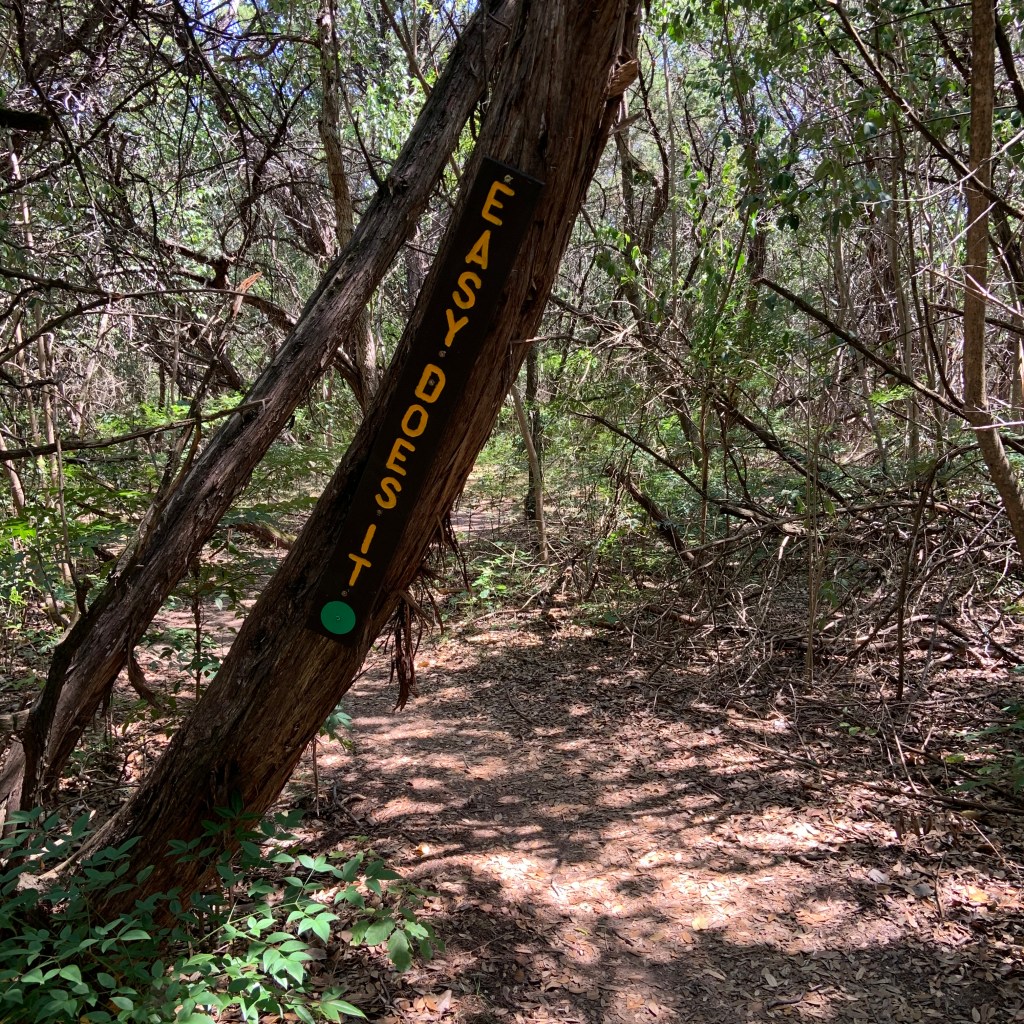
As the podcast episode wrapped up, I found myself a little off my usual hiking path. Apparently I had been listening so intently that I had missed a turn somewhere. And then — cue Ace of Base’s “The Sign” — I saw this:

I had literally wandered onto a trail called “Easy Does It.” I can’t make this stuff up, y’all.

For the record, I have hiked in this park for over a year and have never seen or heard of this particular path. So I couldn’t help but laugh aloud and acknowledge that slowing down, dialing it back, and — dare I say it — enjoying the ride clearly needs to be my focus. So here’s to the next few weeks of messes, dry shampoo, ready-made meals, unread emails, and most of all, letting God surprise me.

Oh and Folklore. Lots and lots of Folklore.

The freedom of trust: Combatting anxiety & exhaustion through childlike faith

At that time Jesus said in reply, "I give praise to you, Father, Lord of heaven and earth, for although you have hidden these things from the wise and the learned you have revealed them to the childlike..."
-- Matthew 11:25

Recently I was chatting with a friend about the pros and cons of renting vs. buying a place to live. Both of us currently rent apartments, and we agreed that although noisy neighbors and lack of space can be major drawbacks, we are huge fans of on-site maintenance. As I explained to my friend, some people love spending their weekends on home renovation projects and relish the ability to customize their living space, but I am perfectly happy hanging some artwork on my unchangeable beige walls and calling it a day. While some people love digging in the dirt and cultivating a gorgeous garden or lush lawn, I’ve stuck to fake plants ever since the Great Basil Fiasco of 2017 revealed that my thumb is anything but green. And although some people have no problem fixing a broken pipe or troubleshooting an appliance malfunction, I’m the actual reason that lightbulb jokes exist. So at least for now, the renter’s life is the life for me.

The conversation then shifted to our childhoods and how we always knew that our parents would be able to take care of anything that went wrong around the house. Even if they couldn’t perform the work themselves, they always seemed to know where to go, who to call, what questions to ask, and what tools to have on hand. Whether it was a random leak or an unwelcome critter, I never feared a single mishap, because I knew Mom and Dad had everything under control. And to be honest, this attitude extended beyond maintenance and repairs; as a child, I never doubted my parents’ ability to handle anything.

Of course, now that I’m an adult, I can look back and smile at my naïveté. I realize that nobody knows what to do in every situation. Most of us are faking it until we make it, and by the time we make it, there are new challenges to fake our way through. But through my younger eyes, my parents were invincible. And although I was certainly an anxious child in many ways, I never doubted their ability to take care of me and to make everything okay. And until more recently, I didn’t realize how incredibly freeing this was. No matter what events transpired throughout the day, no matter how stressed I was about my teachers or schoolwork or not fitting in with my peers, I could sleep peacefully at night knowing that my life was ultimately in good hands.

Last week, as I was praying with the above passage from Matthew 11, I was reminded that Christ invites us to this same freedom, regardless of age or maturity level, in our relationship with God the Father. It’s good to study theology and strive to comprehend the complexities of our faith, but in our quest to become “wise and learned,” it’s easy to forget the beautiful simplicity to which we are called: that of a parent-child relationship. And while it’s important not to mistake childlike for childish, too often “growing up” involves adopting the belief that we’re our own bottom line and striving for total self-sufficiency as a result. And take it from your friendly neighborhood anxiety sufferer here — this is a terrible way to live. This is a recipe for sleepless nights and miserable days spent trying not to crumble under the weight of the world.

I was first introduced to this idea of childlike trust in God about a year ago, when I started diving deeper into the life and works of St. Thérèse of Lisieux. At first, Thérèse’s central message — that the path to holiness can be as simple as embracing our smallness and abandoning ourselves completely to the love of God the Father — seems almost too good to be true. That is, until I actually tried living it out and realized that it might be simple, but it sure ain’t easy. Her “little way” often feels like one giant trust fall, where you wonder, up until the very last second, if there’s really someone back there who will catch you. But Thérèse was greatly encouraged by the words of Isaiah 66:12-13, and we can be, too: “You shall nurse, carried in her arms, cradled upon her knees; as a mother comforts her child, so I will comfort you.” The Lord isn’t just going to catch us; He’s going to hold us, rock us, and comfort us like a parent doting over a newborn.

I’ve come a long way in cultivating a relationship with God that looks more like this rocking chair scenario and less like the parent-in-line-at-Target-with-a-cranky-and-overstimulated-toddler-who-insists-on-doing-everything-herself situation. But as with everything in the spiritual life, it’s an ongoing process. So just when I felt like I was doing pretty well with trusting God to take care of my career, my health, my vocation, my loved ones, etc. — BOOM. Cue global pandemic, with a dash of unemployment for good measure.

These past few weeks have been especially trying — perhaps more so than the initial shutdowns, if I’m being honest. We’re beginning to see the disastrous effects of re-opening the country too early, a one-two punch of cases spiking and public vigilance plummeting. It’s hard not to become consumed by fear of the unknown (or anger at those who aren’t taking precautions and are putting the rest of us at risk). It all feels like a nightmare, a dystopia, and on a personal note, definitely not a great time to be job searching and preparing to move to one of the biggest COVID-19 hotspots in the country (#bestlaidplans). It’s an exhausting predicament with no clear end date in sight.

But once again, Matthew 11 reminds me that whenever I’m exhausted, it’s most likely because I’m carrying burdens that aren’t mine to bear. (Or that I stayed up too late binge-watching Netflix, but as far as I know, Jesus doesn’t address this issue directly.) The Lord doesn’t want me to carry the weight of the world on my shoulders — that’s His job. He doesn’t need me to know how things are going to turn out ten weeks, ten days, or even ten minutes from now — He already knows. He’s not asking me to be everyone’s personal savior — He already took care of that, too. Instead, He invites me into the freedom and respite of radical trust: “Come to me, all you who labor and are burdened, and I will give you rest” (Matthew 11:28).

What if, even in the midst of a global pandemic, I actually lived from this truth? What if I really just did my best, wore my mask, and left the future up to Him? What if I returned to that childlike sense of wonder and security, knowing that in my Father’s house, He’ll fix all the leaks, change all the lightbulbs, and kill all the spiders (or novel coronaviruses) for me?

Part of me hesitated to even publish this post, for fear of sounding like one I’m advocating for a laissez-faire attitude toward real problems. I can assure you, this is most definitely not my aim. Sure, Jesus said, “For my yoke is easy, and my burden light,” (Matthew 11:30), but this still implies that we’re wearing a yoke, and a yoke is an implement of labor. We still need to do the work. But we don’t need to do it alone or in a panicked frenzy, and we don’t need to bear the yoke of the entire world. We can simply do our best with what we have, and know that even when we do lapse into cranky-toddler-at-Target mode, we still have a Father who can’t wait to rock us to sleep.

They shared her joy: Rooting out envy & truly celebrating with others

Meanwhile the time came for Elizabeth to have her child, and she gave birth to a son; and when her neighbors and relations heard that the Lord had shown her so great a kindness, they shared her joy.
-- Luke 1:57-58

There are days when it feels like I have to strain to hear God’s voice, and there are days when it feels like He might as well be speaking through a bullhorn.

There are days when I read a scripture passage over and over, unsure of what I’m supposed to take away from it at that particular moment, and there are days when the Lord might as well have commissioned a blimp to fly over my apartment complex with a particular word or phrase from the day’s reading emblazoned on the side in ALL CAPS.

Last week, I had an experience of the latter. It was a bullhorn and blimp kind of day.

I was praying about some of the exciting new developments in the lives of my family members and friends, and I was admittedly feeling conflicted. On one hand, I was thrilled that good things were happening for my loved ones, especially in the midst of all the pain and suffering in our world right now. But on the other hand, I couldn’t help but feel a little green with envy, which in turn led me to feel ashamed. I should be grateful! I told myself. I’m in good health during a pandemic! There’s a roof over my head and food on my table! It’s time I got my act together and quit throwing myself a socially distanced pity party! Despite this lovely lecture from the ever-so-kind voice inside my head, the conflict remained. So I asked God for the grace to rid my heart of any jealousy so I could be genuinely happy for others.

I then proceeded to open my Bible to the day’s gospel reading, and the above words from Luke Chapter 1 practically jumped off the page. The overall passage was longer and technically focused on John the Baptist, since it was his feast day and all, but I couldn’t get past the first few sentences regarding Elizabeth’s delivery and, more importantly, the reactions of her loved ones. What did they do when they heard the good news that she had given birth? They didn’t grumble or analyze whether or not Elizabeth “deserved” it or ask, But what about me? Instead, “they shared her joy.”

Okay, okay, I thought. Clearly this is something I need to work on. But how? How could I combat envy without resorting back to my usual “just be grateful” mentality, which managed to be both ineffective and shame-inducing at the same time?

My first thought was to keep in mind that there’s always more to the story. I’ve written before about the social media comparison trap, and there’s definitely merit in remembering that what we often see on the interwebs — or even in real life — is only the tip of the iceberg. When we learn that someone has accepted a promotion, for example, we aren’t always privy to the hard work — and perhaps previous rejections — it took to get there. We may also be unaware of the health issues, family drama, spiritual battles, or financial woes this person is facing simultaneously. Too often, we focus only on the “happily ever after” without reading the rest of the tale.

Luke 1:57-58 is actually a great example of this, since it’s just a snapshot of Elizabeth’s story. If we read these verses with no background or context, we might be tempted to think, Well, good for Elizabeth. She sure sounds #blessed. We wouldn’t take into account the many years she waited before becoming pregnant or the fact that she was thought to be infertile. We wouldn’t consider all of the pain and suffering she must have endured leading up to this moment. Snapshots, whether in Bible stories or on Instagram stories, can never convey the fullness of someone’s experience.

But this still didn’t seem like enough. There had to be more to sharing in the joy of others than simply remembering that hey, their lives probably suck sometimes, too. So I re-focused on another piece of the passage and it hit me.

The fact that Elizabeth’s loved ones “shared her joy” after they “heard that the Lord had shown her so great a kindness” reminded me that God was truly giving Elizabeth a gift here — not because of what she had done but because of who He is. None of us could ever do anything to deserve the lavish love or boundless mercy of God, but He’s just so dang crazy about each of us that He wants to bless us anyway. I’m not a parent yet, but all the parents I know seem to agree that there aren’t even words to describe the love they have for their children. How much more, then, does God love us as our Heavenly Father? As Cady Heron famously stated during the Mathletes State Championship at the conclusion of Mean Girls, “The limit does not exist.”

In many ways, I think this cuts to the heart of why I was experiencing jealousy in the first place. Whenever I see someone and think, “I wish I had what she has,” my next thought is usually, “Well, what did she do to earn it? And if I had done something differently, would I have earned it, too?” This line of thinking turns everything into a competition and perpetuates the lie that every aspect of my life is up to me, that if I just try harder or do better, I’ll end up with everything I want.

Of course, I don’t mean to diminish the importance of personal responsibility in determining the trajectory of our lives. But when it comes to so many things — like landing a dream job or finding a loving relationship — we simply don’t hold all the cards. So when I see someone with something that I’d like to have, I need to stop acting like she did everything right, and I did everything wrong, and God simply “rewarded” us based on our input. Life isn’t that black and white, and God isn’t a vending machine. In reality, both she and I probably did some right things and some wrong things along the way.

Which brings me to my final, and perhaps most important, point. Yes, we often don’t know other people’s entire stories, which makes their lives seem oh-so-enviable. Yes, God gives gifts because of His goodness, not because of ours. But most of all, it doesn’t even make sense to compare ourselves to others in the first place because we’re all on our own journeys. And God, as our perfect travel companion, knows exactly what we need and when. (We only think we know what we need, and we usually think we need it now.)

Sometimes the Lord will take us on a detour to help us avoid a hazard on the main route or because we simply need the extra time to think. Sometimes He’ll allow a flat tire so that we can experience the kindness of a stranger who can patch it and point us to the nearest tire shop. Sometimes He’ll take us somewhere we’ve never been and we’ll find, to our great surprise, that we like it more than our original destination. And so on and so forth.

I struggled a lot with this when I turned 28 last year. I realized that my life was essentially one-third over and I had hit exactly zero of the milestones I had hoped to hit by this age, and I panicked. To make matters worse, my high school classmates were making plans for — gasp — our 10-year reunion, and at least according to Facebook, many of them had been collecting these milestones like we all did with Beanie Babies in the 90’s. My peers were now doctors and lawyers and published authors, for Pete’s sake. They were spouses and parents and had mortgages, for the love of HGTV.

After a much-needed pep talk from my parents, I decided that my motto for the year would be “28 and not too late.” And as corn dog as this sounds, it’s been a helpful mantra that has kept me from falling into a whole lot of comparison traps. I can’t possibly be behind on the journey of my own life — only on the journey of someone else’s. Embracing this frees me to be present to what I do have, to enjoy this wild ride, and to genuinely be happy for others. It helps me to clearly see that someone else’s joy or good fortune robs me of absolutely nothing, because I’m living my own unique story complete with everything I need. If anything, their happiness can become my own cause for rejoicing, because at the end of the day, what we’re really celebrating is the fact that we all have such a good Father in heaven.