That magical space: Finding freedom in the sacrifices of love

There is no fear in love, but perfect love drives out fear because fear has to do with punishment, and so one who fears is not yet perfect in love.
-- 1 John 4:18

Last summer, one of my favorite quarantine binge watches was Jane the Virgin. I never saw the series when it was actually on TV, which is probably for the best, since basically every episode ends with some sort of insane twist, and I’m honestly not sure how I would have survived a week or more between installments. As a millennial in the age of streaming, I’m baffled that people had to live this way for so much of TV history. The humanity, y’all!

Of course, not all of the characters or plot points are what you might call “wholesome,” but there’s so much I adore about the show. From the telenovela-style storytelling that appeals to my overly dramatic side, to the narrator’s ability to make me laugh out loud every single episode, to the constant tug-of-war between Team Michael and Team Raphael (both on the screen and within my own heart!), to the simple fact that Rogelio is totally my #Brogelio, the series has definitely earned a place on my top 10 list.

Furthermore, like any good show, Jane the Virgin goes beyond mere entertainment to convey some fundamental truths about the human experience. Prior to my binge watch, I had just finished reading Interior Freedom by Fr. Jacques Philippe, a book that I will be recommending to anyone and everyone until my dying day. Thus, the many facets of freedom — freedom to be ourselves, to accept our lives as they are, to live in the moment, and to overcome the fear and shame that so often hold us back — were top of mind. So not surprisingly, I identified quite a few examples of the concept throughout the show, and one scene in particular was so powerful that I still think about it often. I’d like to share it on this Valentine’s Day — a holiday that often feels overly commercialized at best and riddled with anxiety and baggage at worst — since it reminds us of one of the most beautiful aspects of love.

The scene comes from Season 2, Episode 17, which centers on Jane’s bachelorette party (so #spoileralert if you haven’t made it that far). Despite Jane’s best efforts to plan a responsible, low-key evening, the festivities become increasingly wild thanks to her fun-loving mom, Xo, and best friend, Lina. Meanwhile, Jane’s fiancé, Michael, is at his “bachelor party,” aka a 5-course meal and trip to the spa courtesy of his future father-in-law, Rogelio. Needless to say, neither Jane nor Michael is thrilled about how the celebrations are unfolding. Toward the end of the night, both groups find themselves in the same place at the same time and decide to throw a joint afterparty, and Jane and Michael finally start to have fun. Later, after all the guests have left, the two sit together on the couch and discuss everything that has transpired.

The conversation then turns to their wedding vows, and Jane admits that even as a writer, she’s been struggling to put her thoughts to paper. However, her bachelorette party actually helped her to realize why: “It’s simple,” she tells Michael tearfully. “With you — you make me feel safe in the best way. My mom kept telling me to lose control, but I couldn’t until you got here. Because I know you’re watching over me, instead of me always having to watch over everyone else. So tonight is not my last night of freedom; it’s my first night of freedom.”

Bam, folks. Mic drop.

When you are truly loved by someone — whether a family member, good friend, or significant other — this bond creates a kind of magical space within which you can enjoy a certain degree of freedom. You can grow and change and dream and cry and make mistakes and simply be yourself, trusting that the relationship is not only strong enough to handle it but actually strengthened by this kind of vulnerability. Like Jane, you can let your guard down and discover a sense of peace and security in situations that might normally trigger discomfort or fear.

This magical space becomes an official — and in the Church, covenantal — reality in marriage, when two people publicly vow to stay by each other’s side, in sickness and in health, til death do them part. Unfortunately, our culture so often portrays marriage as a forfeiting of freedom. The very concept of bachelor/bachelorette parties suggests the need for one more wild night before exchanging vows, and the term “settling down” implies that once you’ve said “I do,” you and your spouse suddenly become Mr. and Mrs. Boring McLame.* And of course, by getting married, you do give up some pretty big things: You are no longer able to pursue a romantic relationship with anyone besides your spouse. You can no longer consider only yourself when making decisions and building your life and routines. You’ll have to communicate, collaborate, and compromise like never before. But what do you gain in return? The freedom of love.

The most freeing relationship of all, of course, is our relationship with the Lord. Even the most well-intentioned people will fail us at times, and we will fail them, too. But God loves us perfectly, and as we read in the First Letter of John, “perfect love drives out fear.” I return to this verse again and again when I find myself overcome with anxiety, especially when I worry that my loved ones might finally tire of my weaknesses and decide to blow this popsicle stand after all. The Lord will never leave us. Even at our worst and most sinful, we will never be too much, or too little, for Him. If our minds were capable of fully comprehending this — of understanding the magnitude of His love for us — there wouldn’t be a single speck of room left in our hearts for anything but love in return. Fear and worry would be Marie Kondo-ed right out. And although my anxiety disorder is likely something I’ll have to manage for the rest of my life, I’ve made a lot of progress over the past few years, and I’ve seen glimpses of what fearlessness could truly look like. We certainly sacrifice a lot when we decide to take up our crosses and follow Christ, but in return, the boundaries of that magical space expand to encompass every area of our lives. I can’t imagine a more liberating existence.

So this Valentine’s Day, instead of rolling my eyes at all the overpriced candy, cards, and flowers that have flooded the aisles at HEB or entertaining the ghosts of Valentines’ past, I want to focus on those in my life who, despite their imperfections, serve as a tangible sign of God’s perfect love for me. (Ok, I’ll probably still roll my eyes at HEB a little.) Over the years, my mom has often said to me and my sisters, “There’s nothing you could do that would make me stop loving you.” As a child, I remember being baffled by this idea and trying to think of counterexamples to prove her wrong. As an adult, I’ve stopped trying to find a loophole and have instead begun to accept this kind of fierce, beautiful, boundless, and undeserved devotion. (The woman is an Enneagram 6, after all.) Because ultimately, her words point to an even greater reality: God’s fierce, beautiful, boundless, and undeserved love for me.

*Side note: I think this concept of becoming a “boring adult” has more to do with age/maturity than with marital status. As my unmarried friends and I traverse our late twenties and early thirties, we find ourselves swapping crockpot recipes, opening Costco memberships, purchasing homes, investing money, following actual skincare routines, and thinking that 10 pm sounds pretty darn late. We’re becoming “boring adults,” no spouse required!

The freedom of healing, part two: Wounds that heal us

Yet it was our pain that he bore,
our sufferings he endured.
We thought of him as stricken,
struck down by God and afflicted,
But he was pierced for our sins,
crushed for our iniquity.
He bore the punishment that makes us whole,
by his wounds we were healed.

-- Isaiah 53: 4-5

Healing has been a major theme in my life over the past few years. And the older I get, the more I realize that although some of us certainly have deeper wounds than others, all of us have areas in which we could use healing — whether it be a loss, an illness, a betrayal, a rejection, a poor choice we still regret, or an overly harsh inner critic we can’t seem to silence. Back in September, I wrote a post about how choosing to be healed and actively participating in the process are essential parts of the journey. Today, I’m sharing a personal narrative of how healing can happen in the most unexpected ways once we’ve opened ourselves up to God’s divine treatment plan.


Early last summer, I went to confession for the first time since the COVID-19 shutdowns had begun in March. In order to abide by social distancing protocols, the priest and I had to go outside and stand six feet apart on the church lawn instead of utilizing the cramped confessional. Earlier in my journey as a Catholic, a face-to-face confession would have triggered some major anxiety, but I’ve come to appreciate and even prefer this form of the sacrament more and more. And honestly, after 6+ weeks of being stuck alone in my apartment, I was simply grateful for the in-person company.

Whenever I make a confession, I’m curious to see which sins my confessor will highlight when offering counsel and assigning a penance, and I’m often amazed at priests’ ability to speak directly to what is weighing most heavily on my heart. This time was no different — despite listing my sins in no particular order and maintaining an even tone of voice throughout, the priest honed right in on my inability to fully forgive someone who had deeply hurt me. And because there was no one else in line, he was essentially able to provide me with a mini spiritual direction session (#catholicwin). In order for the Lord to heal me, Father explained, I had to reveal the full depths of the wound to Him. Rather than fast-forwarding to the part where I was able to make peace and move on, I needed to pause and explore why, specifically, this experience hurt so much — how did it make me feel? Betrayed? Used? Forgotten? Ashamed?

Yes and yes, I thought, as my mind replayed one painful memory after another, a highlight reel of all the tiny cuts that together comprised this ugly, gaping wound.

Father also pointed out that we often have trouble forgiving because we think that in doing so, we’re saying that the offense isn’t important anymore or that the wound wasn’t really that severe. However, forgiveness doesn’t mean downplaying the gravity of the situation. Instead, it involves recognizing that holding onto the pain is no longer productive, that it’s hurting us more than it’s hurting anyone else, and that we’re ready to hand it over to the Lord so that we no longer have to carry it ourselves.

I knew he was right, and I wanted so badly to get to that point. But I told him the truth — I just didn’t know how. So he suggested I pray the Litany of Trust, which happens to be one of my favorite prayers, and let God take it from there.

So I did. That, at least, I knew how to do.


Later that summer, I made the 15 ½ hour drive from Texas to Indiana to visit my parents and sisters for a couple of weeks. Normally I would book a flight, but I’ve been leery of flying ever since the pandemic started. So I packed up Little Red (my beloved 2013 Nissan Rogue), downloaded approximately 12 years’ worth of podcasts and playlists (because you never know what mood you might be in!), and hit the road.

After making my way through Texas, Arkansas, Missouri, and most of Illinois, I decided to stop one last time to fill up my gas tank, eat a snack, and stretch my legs. As I climbed back into the car after my pit stop, I could feel a second wind coming on. It was a beautifully clear evening, with tall summer corn stretching for miles in every direction, and I was less than 2 hours from being able to hug my family tight for the first time in months. So I cranked my roadtrip playlist a little louder and began to sing along.

If this were a movie trailer, you’d probably hear a voiceover from one of the other characters right about now. He or she would say something cliche like, “Sometimes, all it takes is a single moment for your life to change forever.” Because one second, I was flying down country roads without a care in the world, and the next second, I was colliding with another car at roughly 60 miles per hour.

Thanks to that trusty summer corn, neither of us saw the other until it was too late. Time seemed to slow down in the moments just before our vehicles made contact, then speed back up again as a gut-wrenching cacophony of screeching tires, shattering glass, and metal clanging against metal rang through the evening air.

I don’t have any memory of what happened next (and thank God for that), but I am told that after smashing into the first vehicle, Little Red careened into a second vehicle parked at a nearby stop sign, then screeched to a halt a few dozen yards away. What I do remember is coming to a few moments later, my hands in a death grip on the steering wheel, unsure of whether I was dreaming or actually living this nightmare. I was afraid to move, because what if I discovered that I couldn’t move? However, my engine was making some disturbing noises, so it was probably best for me to get out as fast as I could.

With trembling hands, I cut the ignition and attempted to devise an exit strategy. This was extra difficult given that my thoughts were as shaken and scattered as the contents of my car, but I did my best to gather them up again. Both of Little Red’s front doors had caved in, so it looked as though I would have to shimmy out the back. As I fumbled over the center console, my whole body now trembling uncontrollably, I heard a woman’s voice call out from a distance.

“Are you okay? M’am, are you okay?”

I did a quick inventory — my heart was pounding, blood was dripping from somewhere yet to be discovered, and I felt like I might throw up, but so far I was able to move all of my limbs. So I yelled back, “Yes, I think so! I’m okay!”

When I finally stumbled out of the car a few minutes later, I was shocked by the scene unfolding around me. People were everywhere. Five or six individuals had climbed out of the other two cars. The residents of the only house within view had rushed outside. And before I could even think to call 911, police cars, firetrucks, and ambulances began to arrive. First responders blocked off the intersection, which was strewn with scraps and parts, and quickly began examining each of us for signs of a serious injury. As an EMT took my pulse, I was certain it must be 1000 beats per minute. I was able to provide my name and date of birth, but when they asked who would be coming to get me, I couldn’t remember the make and model of my mom’s car. It’s white, I said, and then the search engine of my brain produced no more results.

By the grace of God, though, all of us walked away from the wreck relatively unscathed. The blood I had noticed earlier was coming from my left arm, where the skin had been sliced away by the driver’s side airbag. I developed some mild concussion symptoms over the next few days (mainly brain fog and memory loss), along with some pretty serious soreness and exhaustion. But given the circumstances, we were incredibly fortunate. This was the ninth accident at that poorly-marked intersection, and others had fared much worse, with cars rolling into the cornfield or going up in flames. My beloved Little Red had seen her last day, but in her final moments she had saved me. And ultimately, nothing irreplaceable had been lost.


A funny thing happened in the wake of the wreck. It was a horribly unfair event — no one had done anything wrong, and yet because of a simple lack of signage, all parties faced insurance dealings, substantial repair or replacement costs, and the shared trauma of a major accident. Nonetheless, in so many ways, I felt an unexpected peace and lightness. Some of this surely stemmed from my immense gratitude for simply being alive, but it was so much more than that.

Over time, as the abrasion on my arm turned from blood red to black and blue to the pale pink of scar tissue, I thought back to that day in confession, when I had prayed the Litany of Trust and left a seemingly hopeless situation in God’s hands. I am certainly not saying that He caused a 3-car accident in order to help me work through some personal issues. And I’m not saying that the wreck alone was a panacea for all past hurts — healing has taken a lot of prayer, spiritual direction, time, tears, and therapy as well. However, God did allow the accident to happen, and in His goodness, He has used it to help me get to a place where prayer, spiritual direction, time, tears, and therapy hadn’t allowed me to go yet. I finally felt free — unchained from the anger, hurt, and resentment that had previously been holding me captive. The forgiveness that had once felt impossible now seemed within reach. I actually hope my scars never fade completely, because I love carrying such a visible reminder of God’s goodness, mercy, and providence everywhere I go.

This experience has also brought me to the cross, where Christ sustained unimaginable wounds for our sake. As Jesus tells us, “I came so that they may have life, and have it abundantly” (John 10:10). His teachings, although often misconstrued as rules and regulations, actually serve as a roadmap to a life of abundance. His example of forgiveness — even and especially when it’s undeserved — can feel impossible or unfair, but ultimately, casting blame, demanding explanations, and withholding mercy only serve to enslave us and force us to toil under the back-breaking burden of resentment. In the moments just before the wreck, I had seen my life flash before my eyes, and I now realized that it was too short, too sweet, and too precious to spend another second living it this way.

Of course, remnants of the original wound, and of the wreck itself, still rear their ugly head on occasion. I still find that I’m not able to trust others as much as I would like because of the places in which my trust was previously broken. I’m still a little jumpy on the road and get triggered by loud noises that remind me of the accident. But by and large, I have been able to forgive. I have been able to move on. And I have been able to find deep joy where there was once a deep cut. Praise God for the wounds that bring us healing.

Great expectations: Discovering a hope that doesn’t disappoint

More than that, we rejoice in our sufferings, knowing that suffering produces endurance, and endurance produces character, and character produces hope, and hope does not disappoint us, because God's love has been poured into our hearts through the Holy Spirit who has been given to us.
-- Romans 5: 3-5

Can you believe it? We’ve almost made it through 2020, y’all.

It’s not that I expect the pandemic — or any of our other problems, for that matter — to magically disappear when the clock strikes midnight on New Year’s Eve. However, I do think it’s worth taking a moment to appreciate that we’ve made it this far and opening our doors and windows to any fresh breezes that 2021 may send our way. Plus, we’re now officially in the Christmas season — a time of renewed awe, hope, and wonder. (Even if you’re not Catholic, I highly recommend adopting our tradition of continuing the festivities all the way through the Feast of the Baptism of the Lord, which falls on January 10 this year.) And boy, did Christmas come just in time.

Our world feels wearier than ever — weary of the pandemic, of political divisiveness and unrest, of financial uncertainty and strife, and of fear and isolation and mistrust that permeate the very homes and families that were meant to offer a safe haven from these troubles. As I edit this post from the waiting room of my car dealership, a nearby television blares one depressing news headline after another like a litany of reasons to despair. (I literally just had to sit through a eulogy for a precious baby who died of cancer and try not to cry in front of my fellow Nissan customers.) We long for the “thrill of hope” that we sing about in our favorite carols. But in order for that hope to truly satisfy and sustain us into 2021 and beyond, it needs to be rooted in the right things. Specifically, it needs to be rooted in the right person — Jesus. Not long ago, I had to learn this the hard way, after placing my hope in ALL the wrong people, places, and things.

2019 was undoubtedly one of the hardest years of my life. There were many contributing factors, but to borrow a line from Taylor Swift’s new album, “Long story short, it was a bad time.” By the time the holidays came around, it felt like everything had unraveled and I was sitting in a mess of loose threads, unsure of how or where to begin the process of disentanglement. The prevailing emotion? Deep disappointment. I had started the year with such wide-eyed enthusiasm, only to end up more jaded and disillusioned than ever.

So you can imagine the major eye-roll I did when I came across the above passage from St. Paul’s letter to the Romans one day. Hope does not disappoint?! I thought. I beg to differ! It seemed as though my tendency to dream big and look on the bright side was precisely what had gotten me into this mess. As Panic! At The Disco would say, “I had to have high, high hopes for a living” — and as a result, I had witnessed just how far these hopes enabled me to fall.

However, I sensed that the opposite approach — i.e., expecting nothing to avoid a letdown — wasn’t the solution, either. After all, hope is a theological virtue woven throughout the entirety of scripture and salvation history. We need it, and let’s be honest, we want it. So what was I missing? What kind of hope never disappoints?

One of my first major turning points occurred while I was reflecting on the story of the Road to Emmaus. It’s a passage I’d heard many times before, but until more recently, I didn’t realize what it could teach me about hope and my own tendency to doubt.

That very day two of them were going to a village named Emma'us, about seven miles from Jerusalem, and talking with each other about all these things that had happened. While they were talking and discussing together, Jesus himself drew near and went with them. But their eyes were kept from recognizing him. And he said to them, "What is this conversation which you are holding with each other as you walk?" And they stood still, looking sad. Then one of them, named Cle'opas, answered him, "Are you the only visitor to Jerusalem who does not know the things that have happened there in these days?" And he said to them, "What things?" And they said to him, "Concerning Jesus of Nazareth, who was a prophet mighty in deed and word before God and all the people, and how our chief priests and rulers delivered him up to be condemned to death, and crucified him. But we had hoped that he was the one to redeem Israel. Yes, and besides all this, it is now the third day since this happened..."
-- Luke 24: 13-21

Here we have two men, walking and talking as they attempt to wrap their minds around some pretty crazy events that have unfolded. Their long-awaited savior had finally arrived — or so they thought — and after demonstrating His power and wisdom through a series of miraculous healings and rousing sermons, He was humiliated and murdered alongside two criminals. And as far as these men were concerned, that’s where the story ended.

They were likely experiencing a variety of different emotions — sadness, shock, and fear, to name a few — but disappointment was definitely in the mix. You can practically hear it dripping from their voices as they say, “But we had hoped that he was the one to redeem Israel.” As in, “This Jesus guy really seemed like the real deal. But now he’s dead, and it’s been 3 days. I guess we were wrong. Now what?”

They had gotten their hopes up. They desired to believe in Christ’s promises, but when things didn’t look like they wanted or expected, they were disappointed, and doubt started to creep in.

A few verses later, Jesus points out their error:

And he said to them, "O foolish men, and slow of heart to believe all that the prophets have spoken! Was it not necessary that the Christ should suffer these things and enter into his glory?" And beginning with Moses and all the prophets, he interpreted to them in all the Scriptures the things concerning himself. 
-- Luke 24: 25-27

The prophets had predicted that things would unfold this way and had spelled it out in the scriptures; yet, the men still questioned and doubted and just plain forgot. It’s easy for me to criticize their ignorance or lack of faith, but y’all, I do this all the time. I definitely did this amidst the Great Dumpster Fire of 2019. Lord, my life really isn’t going as planned. For a while I felt like we had a “thing” going…I was doing my best to follow you, and everything was going pretty well! But now it’s all fallen apart. What happened to your promises? What happened to the “great plans” you supposedly had for me?

We can contrast this to Mary’s fiat, one of the highlights of our Advent readings over the past few weeks.

In the sixth month the angel Gabriel was sent from God to a city of Galilee named Nazareth, to a virgin betrothed to a man whose name was Joseph, of the house of David; and the virgin's name was Mary. And he came to her and said "Hail, full of grace, the Lord is with you!" But she was greatly troubled at the saying, and considered in her mind what sort of greeting this might be. And the angel said to her, "Do not be afraid, Mary, for you have found favor with God. And behold, you will conceive in your womb and bear a son, and you shall call his name Jesus. . . And Mary said, "Behold, I am the handmaid of the Lord; let it be to me according to your word." And the angel departed from her.
-- Luke 1: 26-31, 38

Understandably, when the angel Gabriel came to Mary and announced that she would give birth to the Son of God, she had a few logistical questions. (Can you blame her?) But ultimately, she accepted God’s plan and gave her “yes” wholeheartedly, because she knew and understood the scriptures, and therefore she knew and understood the character of God. He was someone she could trust without reservation, even when she didn’t know all the details of the plan, and even when the plan would inevitably involve suffering. As Mary’s cousin Elizabeth later proclaimed, “Blessed are you who believed that what was spoken to you by the Lord would be fulfilled” (Luke 1:45). Mary placed her hope in the Lord and His promises — and in these things alone.

Of course, I had thought I was doing the same, but when I took an honest look at the Epic Pile of Burning Garbage that was 2019, I saw how often I misplaced my hope or misconstrued God’s promises to fit my own desired narrative. For example…

  • God promises to always be with me (Matthew 28:20), but this doesn’t mean I will always feel His presence. I will experience periods of spiritual desolation as well as consolation, valleys as well as mountaintops.
  • God promises to provide me with all that I need if I seek His Kingdom first (Luke 12:22-31), but what I actually need and what I think I need often differ immensely. Sometimes He will even withhold something I think I need so that I learn to lean more heavily on Him.
  • God promises to work all things for good for those who love Him (Romans 8:28), but this doesn’t mean that I will always see or understand this good in my lifetime. Just typing that sentence makes me want to hurl my laptop out the window and say some choice words, because I want so badly to understand all the things and immediately find meaning in all of my pain. But I’m learning to live with some unanswered questions and loose ends and trust that God will resolve them at the appointed time.
  • God promises that His plans for me are ordered toward my welfare and not my woe (Jeremiah 29:11), but this doesn’t mean that my life will always be easy, fun, or free from suffering. The Lord is looking at the big picture, so he will permit some woes — even significant ones — in order to bring about the greatest welfare of all — my salvation.

I still have a long way to go in learning how to balance big dreams with harsh realities; to set ambitious yet flexible goals; to appreciate the goodness in my career, relationships, achievements, hobbies, and possessions without expecting these things to satisfy the deepest longings of my heart; and to anchor my hope in truth and not simply wishful thinking, tired clichés, or prosperity gospels. But I now understand what Paul meant when he spoke of a “hope does not disappoint us.” He wasn’t talking about the kind of flowery Hallmark hope that we often associate with the “magic” of Christmas. He wasn’t talking about false optimism or simply “looking on the bright side.” He was talking about the fact that we don’t just have a deity or a distant god who can’t be bothered — we have an Emmanuel, a Lord who loves us so much that He willingly — gladly — became a human to endure all the grit and grime and messiness of life with us, all while enacting His plan to ultimately save us from it.

That’s the thrill of hope. May our weary world — and our weary hearts — learn to rejoice in it.

Adventures in online dating, part two: My Coffee Meets Bagel experience

Oh hey! It’s been a minute. Anyone still there? Is this thing still on? I hope so, because I have SO much to share!

The past few months have been a wonderful whirlwind of starting my new job, reconnecting with friends, and settling back into the rhythm of life in Houston. After 3 years of nearly constant change, I can truly say that this has been one of the most joy- and peace-filled transitions I’ve ever made. I plan to dive more into that on the blog soon, but for now, I want to revisit the subject of online dating.

In my last post, I talked about why I finally decided to try it after years of loathing the idea, how I chose a platform, and how it all commenced with The Great Bagel Mix-Up of 2020. (And to think I ever doubted that God would be able to write me a great story. HA.) Today, I’ll share more about my actual experiences and what I’ve learned about myself, about this brave new (virtual) world, and about what I’m truly looking for.

Overall Experience

First, some basic stats:

  • I started by downloading Coffee Meets Bagel and utilized the app for a total of 8 weeks.
  • In that time, I went on 12 dates with 6 different guys (4 dates with one guy and just 1 or 2 with the rest).
  • I also messaged with a number of other “matches” that never culminated in a date, either because the conversation fizzled or I sensed a red flag. (For example, I asked one guy if we could postpone our coffee date due to a major headache, and he clearly thought I was flaking because he replied that he was a “catch” and I was “missing out” on his great personality. So I decided to let him miss out on mine. *sips tea*)

In general, I would say that my brief experience with CMB was a positive one. It seemed like the majority of users were, in fact, looking for some sort of committed relationship, and connecting with kind, funny, and intelligent guys who treated me with respect low-key restored my faith in humanity. I did endure some ghosting (which I expected), some gaslighting (which I did not expect), and one experience that can best be described as the Smelly Fish Market Saga (an evening for which nothing could have prepared me). But overall, I’m grateful to have connected with some solid dudes and confirmed that after a year off, I am indeed ready to date again.

And a note about dating during COVID: Meeting people during a pandemic might be a challenge, but I’m not going to lie, I’m kind of a fan of what it’s done for first dates. Instead of drinks in a dark and crowded bar, activities like going for a walk or sitting outside at a coffee shop are now go-to’s. Staying 6 feet apart really takes the pressure and emphasis off physical intimacy and shifts the focus to quality conversation. And although the conventional wisdom is to avoid tackling deep/controversial subjects on a first date, I think it’s a good idea to start learning about what your date truly values early on. And there’s nothing like discussing the tumultuous events of 2020 to help hone in on someone’s character. So tell me, Steve, how do you feel about wearing masks?

What Went Well

Despite having no idea what I was doing, I feel good about how I handled certain aspects of online dating.

  • I created a profile that genuinely reflected my personality. It was tempting to include only photos that showed me dressed to the nines or to list hobbies or personality traits that made me sound more “exciting.” However, I wanted to attract the right kind of guy, not just any guy, so I knew I needed to be honest. I chose a few “cute” photos as well as a no-makeup hiking selfie that I originally took to send to my family. I mentioned outright that I’m looking for someone who shares my faith. And I listed hobbies like writing and creating Spotify playlists so any potential date would know he’s probably not looking at a thrill-seeking party animal.
  • I filtered my searches by qualities that are truly important to me. Even though there were a lot of seemingly great guys who identified as “spiritual but not religious,” I intentionally matched only with guys who were Christian or Catholic. If I ever hope to marry someone who shares my faith, then it only makes sense to date people who do as well.
  • I stayed true to myself in conversations and on dates. I didn’t force my beliefs on anyone, but I also didn’t shy away from expressing them if the opportunity arose. This actually led to a number of great conversations about life, religion, past dating experiences, personality tests, music, food, travel, and more that went deeper than surface-level. And if nothing else, I helped at least a few guys identify their enneagram type. They can thank me later.
  • I kept my cool throughout the ghosting and gaslighting. It was tempting to take it personally when someone stopped responding with no explanation, but I quickly learned that the only way to survive online dating is to make like Ariana Grande and adopt a “thank u, next” mentality. Let people take themselves out of the running so you don’t have to.

What Didn’t Go So Well

Of course, CMB wasn’t all sunshine, rainbows, and mature decisions. If I had to do it again, I’d handle some things differently.

  • I tried to juggle too many conversations and dates at once. Holy moly, y’all. 12 dates with 6 guys in 8 weeks might be fine for some people, but it was too much for me, especially when the dates were scheduled too closely together. But because CMB presented me with a dozen new “bagels” each day and I had just 24 hours to accept/reject them before they disappeared into the dating ether, I felt pressured to keep matching even when I already had more bagels than I could handle.
  • I didn’t have a solid plan for getting out of bad dates or turning down 2nd date offers. Sometimes you realize, after an hour or two of chatting, that you just aren’t feeling a connection — but the other person asks you out a 2nd time anyway, right there on the first date. I have a pretty solid text message template for politely turning down an offer, but in person, before I’ve had a chance to think it through, I tend to choke or even lie. I’m not proud of this and wish I had come up with a better exit strategy on several occasions.
  • I didn’t call my dates out when needed. I can think of several instances when my date said or did something out of line, and I didn’t react strongly enough. For example, when one of my dates made a few racist comments, I was so taken aback that I didn’t know how to respond. My tendency to be overly polite and non-confrontational kicked in and I brushed it off, but I so wish that I had spoken up instead.

What Happened Next

At this point, you’re probably thinking, Okay, Paige, enough with the recap — why did you delete the app? Did you find that special someone? Did you switch to another platform? Or was the Smelly Fish Market Saga simply too traumatic and now you’ve sworn off dating and are discerning religious life?

While the latter certainly was a date that will live in infamy, ultimately, my CMB experienced helped to crystallize something that I’ve always known but am often hesitant to admit, for fear of narrowing the dating pool too much:

I really, really want to date a committed Catholic who is on fire for his faith and shares my love of the Eucharist.

Obviously, faith alone is not enough — we need to connect and be compatible in many other ways as well — but without this shared foundation, it’s difficult for me to envision the kind of relationship and future that I truly desire.

So although I was meeting some nice Christian and even Catholic guys on CMB, it was difficult, based on the setup of the app, to determine who was really serious about his faith and who was Christian in a more cultural sense. The profile questions simply didn’t dig that deep, and more guys than not fell into the latter category. Long story short, I decided to do something that, in the 5 years since becoming Catholic, I swore I’d never do…

I signed up for Catholic Match.

(Cue horror movie-style scream.)

Obviously, Catholic Match is a reputable site with a number of success stories. However, from my own friend circles, I had also heard some pretty cringeworthy tales — from an onslaught of creepy messages within days of joining the site to dates with guys whose sole objective was to get married and have a small army of children ASAP. Plus there was a monthly FEE and I am on a BUDGET that doesn’t include “Catholic dating nightmares” as a line item. (However, Catholic Dating Nightmares is an excellent Instagram account that you should totally follow.) I just really, really didn’t want to do it.

But then I thought back to Isaiah 55:8-9 — the verse that helped me to get over my resistance to online dating in the first place — and realized that once again, I needed to get over myself. If I wanted to find a committed Catholic amidst a global pandemic, I needed to be more open to trying Catholic dating sites. So I rolled my eyes, set up a profile, and paid for a one-month subscription.

…And that’s where I’ll leave you for now! This post is getting hella long, and CM is definitely deserving of its own post. But before I go, I want to share two recommendations for my fellow online daters:

First, I have really been enjoying the Dating Sucks podcast, hosted by Ilana Dunn and Jonah Feingold, two millennials who met on Hinge, called it off after 4 dates, and then started a podcast together. I love how the show blends data-driven strategies and expert advice with relatable stories to help solve common online dating struggles, and the fact that Ilana actually works for Hinge contributes an additional layer of insider knowledge.

Secondly, when I was initially getting back into the dating game, I found it fun and helpful to watch a few episodes of Dating Around on Netflix, a show that is much classier than its name suggests. In each episode, one guy or girl goes on five consecutive first dates with total strangers before choosing one of these individuals for a second date. If you’ve ever felt discouraged by the awkwardness of first dates, this show will remind you that you’re not alone — and that awkward and awesome can still co-exist.

And don’t forget to check out my Someone New playlist on Spotify! From getting ready to getting ghosted, it’s a soundtrack for all your online dating needs.

Adventures in online dating, part one: Why I’m trying it & how I chose a platform

For my thoughts are not your thoughts, 
neither are your ways my ways, says the Lord.
For as the heavens are higher than the earth, 
so are my ways higher than your ways
and my thoughts than your thoughts. 
-- Isaiah 55: 8-9

If y’all are wondering how on earth I intend to link a passage from Isaiah to the subject of online dating, then sit back, grab some popcorn, and enjoy the show, my friends!

As I’ve said before, I never really planned to talk about dating or relationships on the blog. Despite my desire to be authentic and vulnerable with my readers, these topics have felt…a little too authentic and vulnerable. But lately, I’ve been feeling a tug to share my experiences while I’m still in the messy middle of it all, to say all the things I wish someone would have said to me before, and if nothing else, to let others who are single and searching know that they are absolutely not alone. (Despite what your social media feeds may suggest, not everyone you know has found his or her One True Love.) And based on your feedback thus far, it seems like this stuff resonates. So today, I’m tackling a hot topic that’s become even more sizzling since the pandemic began: online dating.

It should be noted that I’m still very new to this world — in fact, I downloaded my first dating app just seven weeks ago in a lively series of events now known as The Great Bagel Mix-Up of 2020. But more on this rollicking tale in a bit — first, let’s start with the “why.”

Why I started using dating apps

Prior to this year, I simply hadn’t felt a need or desire to try online dating. My first serious relationship started the summer after I graduated from college, and since then, I have dated pretty consistently just by meeting people the “old fashioned” way: at a party, at an event, or even at work. And for a hopeful romantic like myself, this is exactly how I’ve always wanted it to be! I often joke that my dream would be to meet someone in the produce aisle at H-E-B when we both reach for the same apple at the same time, but…I’m not entirely joking. I’ve always dreamt of a great story complete with all the humor and whimsy of a 90’s romcom, a “meet-cute” that feels a little like chance and a little like destiny. Although there’s nothing inherently wrong with this, I had become so attached to the desire that I had essentially closed myself off from meeting someone via any other route — especially when that route felt as contrived and superficial as the internet.

Enter 2020.

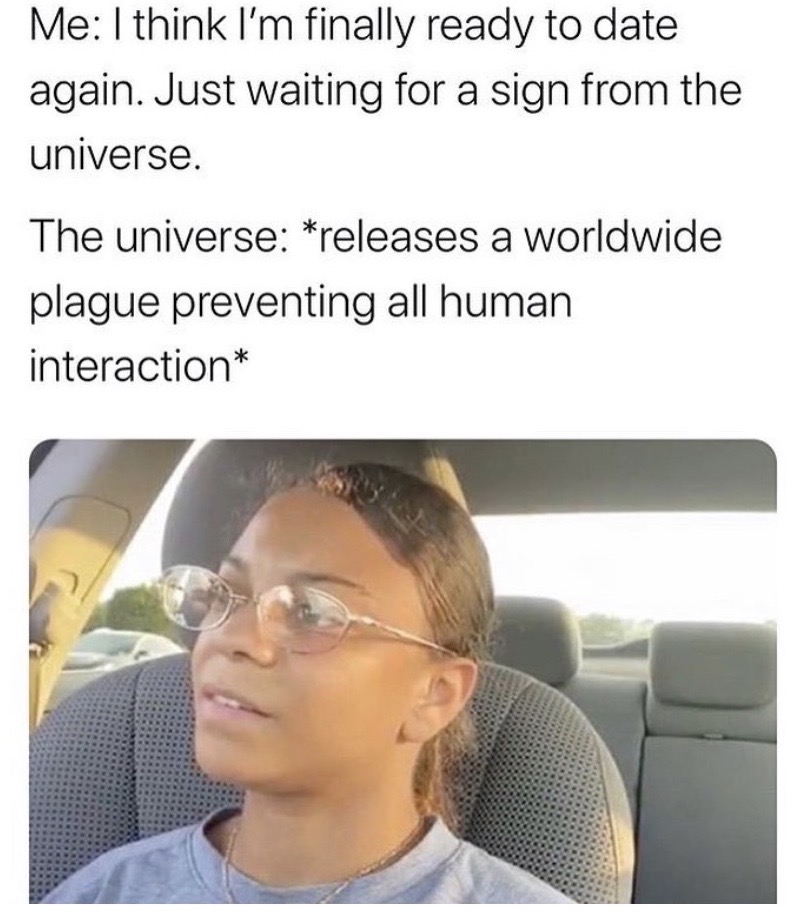
After taking a yearlong dating hiatus, I finally found myself ready to get back in the game — amidst a global pandemic. Impeccable timing! H-E-B suddenly went from my ideal place to meet that Special Someone to the only place I got any human interaction at all — and even then, from 6 feet away and with masks covering most of our faces.

This meme pretty much sums it up:

Source: https://www.instagram.com/iamthirtyaf/

Furthermore, I was starting to realize that even though I have lots of friends and am involved in a variety of activities and ministries (“adult extracurriculars,” as I like to say), I have largely exhausted the dating options in my existing social circles. I needed to expand my horizons, and with COVID-19 greatly reducing the possibility of meeting new people IRL, it seemed that online dating was a logical next step.

I knew this in my mind, but I really struggled with it in my heart. Perhaps one too many Taylor Swift jam sessions are to blame, but my desire to meet someone in person was so strong. Plus, online dating seemed to produce such mixed results. For every person who found a lifelong partner, it seemed that there were several more who endured a series of ghosting and dead-end dates — along with the occasional creepy stalker — to no avail.

This is where the above scripture passage comes in. I started realizing that I was limiting God to my own ideas of what a love story should look like. As I mentioned in my recent post The Truth About Singleness, I don’t believe that I’m guaranteed to find a husband simply because I desire to get married. However, I do believe that if I find a husband, our love story will be beautiful — because real, lasting, sacrificial love is what makes stories beautiful. It’s not about the meeting — it’s about the thousands of times both of us continue to show up after that. Furthermore, how many times have I been wrong in determining how my life should look? How many times have my ideas not been the best ones? Too many to count. God’s ways are not my ways, and praise Him for that. They are SO much better.

And yes, I might have to endure some painful or awkward dates along the way. But if I feel called to marriage, then my duty in this moment is to be open to dating, regardless of the outcome. I think this is an important part of vocational discernment — seeking God right where we are and taking the “next right step” as appropriate, rather than focusing obsessively on the destination. So these perspective shifts, along with some gentle encouragement from my friends and spiritual director, helped me to put aside my pride and preconceived notions and give online dating a go.

How I chose a platform

This part was simple. Starting out, I knew the following:

  • I wanted a platform that would allow me to filter/search by religious beliefs; however, the site didn’t have to be designed solely for Christians or Catholics.
  • I wanted a platform where the majority of users were looking for long-term relationships rather than casual dates or hookups.
  • I wanted to start with a free service rather than commit to a paid subscription right away.

I had heard the greatest number of positive reviews — and the fewest number of horror stories — for Coffee Meets Bagel, so I decided to start there.

The Great Bagel Mix-Up of 2020

My original intent was to wait to date until I moved back to Houston and got settled in. However, about a week or two before the move, I decided that it “couldn’t hurt” to start laying some groundwork. (Famous last words.) So one night, I downloaded Coffee Meets Bagel and began entering some basic demographic information. Somewhere around the “upload photos” stage, I drifted off to sleep, and when I woke up the next morning, I had largely forgotten about my evening escapades.

So imagine my surprise when, at exactly 12 pm, I received a notification on my phone announcing, “Your bagels are ready!”

It took my brain a few moments to register what was happening. My initial thought was, Bagels? Did I order Panera online and not remember?! It seemed like a reasonable explanation, since it was lunchtime, I have the Panera app on my phone, and online ordering has been my go-to ever since the pandemic began. But then I noticed the CMB logo and realized with horror that I hadn’t just downloaded the app and started exploring — I had also set up a publicly visible profile! And now I had bagels! (In CMB speak, “bagels” are simply potential matches that the app suggests for you at noon each day.)

So obviously, I did what any reasonable person would do in this situation: I panicked, deleted the app, and posted about the incident on my Instagram stories. But then I started getting a lot of encouraging responses from friends and followers: “Go for it!” and “So happy for you!” and “Don’t wait!” they said. “It’ll be fun!” they said. So I paused and reconsidered.

I realized that maybe it wouldn’t hurt to start finding some matches and striking up a few conversations. And besides, knowing me, I would probably get to Houston and find other excuses as to why it still wasn’t the “right time.” So later that day, I re-downloaded the app, finished setting up my profile, and decided to see what bagels I had in the toaster — er, queue.

In the interest of capping this post at a manageable length, I’ll pause here. (Ha! The suspense!) In a future update, I’ll share my actual experiences with the app as well as what I’ve learned so far. In the meantime, I’ve created a fun little Spotify playlist to capture all the ups, downs, and adrenaline rushes that come with this wild world of online dating. I’ve been jamming to it whenever I get ready for a date, and I can personally attest that blasting Taylor Swift’s ME! after you get rejected or ghosted helps at least a little. Enjoy!