Preparing the gifts: Cultivating patience in a season of waiting

When it comes to the liturgical calendar, I’ve always been more Team Lent than Team Advent.

I realize I’m firmly in the minority here — almost every other Catholic I know goes full-on Buddy the Elf when it comes to Advent but approaches Lent with a vague sense of dread and trepidation. At a basic level, this makes sense. The weeks leading up to Christmas are filled with fun and festivity, with baking cookies and exchanging gifts and watching endless hours of hopelessly predictable Hallmark movies (at least in my family). What’s not to love? The weeks leading up to Easter, on the other hand, are essentially the opposite: a fast instead of a feast, a time of reflection and repentance with little to no secular traditions to accompany it. And there are definitely no Hallmark movies — I don’t envision Kiss Me at the Fish Fry or Don’t Give Up Love for Lent becoming blockbusters. (Either that or I’ve totally stumbled upon an untapped market! Let me know in the comments below.)

But perhaps this stark contrast highlights precisely why I’ve always been partial to Lent — it feels so much more simple and straightforward to enter into the season. We make sacrifices to rid us of unnecessary attachments, to demonstrate contrition for our sins, and to unite our suffering with that of Christ on the cross. And because there typically aren’t a million places to go and people to see during Lent, we’re able to actually slow down and take stock of our relationship with the Lord, to see what’s holding us back from true intimacy with Him. That way, when Easter finally arrives after 40 days of somber prayer and reflection, the joy we experience is that much more profound — much in the same way that dimming the lights at the beginning of Easter Vigil mass makes the illumination of the sanctuary during the Gloria all the more stirring.

Living Advent, on the other hand, is a bit more…confusing. In the eyes of the Church, it’s technically a penitential season as well — and yet, everywhere we look there are cookies and parties and gifts and COOKIES, y’all. We’re supposed to be quieting our hearts and minds and waiting for the coming of our Lord, but when does one find time for this in between all the shopping and baking and general merrymaking? As I alluded to before, a lot of this tension stems from today’s society, which starts celebrating Christmas the day after Halloween and encourages us to spend all of November and December in a full-on holiday frenzy. But this year, more than any other year before, I’m realizing there’s another dimension to my struggle. Advent isn’t just difficult because of external pressures. Advent is difficult because I simply don’t know how to wait well.

Case in point: While in line at the grocery store, I often find myself slowly edging my cart closer and closer to the poor soul ahead of me as I not-so-subtly tap my foot and glance repeatedly at the time on my phone. If I have to wait on hold for more than a few minutes, I’ll hang up the phone altogether — after all, who needs the bank, the doctor, or the insurance company? And if I’m hungry, or worse, hangry, it’s everything I can do to not plunge into the depths of despair as I wait 2 entire minutes for the microwave to reheat my leftovers. I don’t recall being this way as a child, but now, in the age of fast food, high-speed internet, and Amazon Prime, I’ve become the living embodiment of the song “We Need a Little Christmas,” emphasis on “RIGHT THIS VERY MINUTE.”

I didn’t realize just how impatient I had gotten until I started dating Mr. Pink Tie. He is an incredibly patient man, one who never fails to laugh in amusement as I count down each excruciating microwave minute. And ever since we got engaged, it’s felt nearly impossible to wait for the wedding! I am so excited for our special day, when all the people we love most in the world will be in one place, when we will enter into not just a contract but a sacrament, and when we will celebrate this sacrament with good food, good wine, and bad dancing (I certainly put the “bust” in “bust a move”). And of course, I’m even more enthused for our actual marriage, when we’ll get to see each other every day, build a home and family together, and endure all the ups and downs of life by each other’s side. It’s all so exciting that our wedding date can feel like a lifetime away.

And so I’ve been reflecting on the parallels between Advent and our engagement. If lived well, both are times of preparation and joyful anticipation. There’s obviously preparation on a practical level — before our wedding, we have to plan the mass, coordinate the reception, complete all of our diocese’s marriage prep requirements, find a place to live, and more. There’s also preparation on a spiritual level, such as regularly receiving the sacraments, praying with and for each other, and seeking healing in areas where we may be wounded. Sure, we could elope tomorrow (and the thought has definitely crossed our minds), but then we would miss out on this precious time of building a solid foundation for the rest of our lives.

Advent is filled with a myriad of practical preparations as well: shopping, decorating, cooking, baking, and coordinating travel, to name a few. But on a spiritual level, the Church encourages us to build in time for silence and stillness, for prayer and penance. The mass readings invite us to truly journey with Mary and Joseph — quietly, steadily, patiently — longing as they did for a savior. We could skip straight to Bethlehem, but then we would miss out on what the Lord wants to do in our hearts as we lift our eyes from the darkness and follow that one bright star.

Recently, I shared my struggles with impatience with my spiritual director. As always, she had a wise and discerning response that changed my perspective on engagement. She reminded me that during this time, God is preparing the gifts of two individuals for each other. To ready us to both give and receive this gift, the Lord wants to heal and transform myself and Mr. Pink Tie like never before. In a way, our whole lives have been preparing us for our vocations, but that preparation accelerates and intensifies in the months leading up to “I do.”

I think something similar could be said of Christmas. We know that the magi brought gold, frankincense, and myrrh to the Christ child, but more importantly, they brought themselves. Although they lacked the modern convenience of overnight shipping, they could have certainly sent their regards with someone of less importance so they could continue, uninterrupted, with their busy lives. But instead, they dropped everything and made the long journey themselves, and this must have pleased God far more than any precious metals or expensive perfumes ever could. During Advent, as with engagement, our Lord is preparing the gifts of two individuals for each other. As Jesus develops in Mary’s womb, growing into our long-awaited savior, the Holy Spirit readies our minds, hearts, and souls so that we can bring our full selves to the manger, so that we can drop everything and experience the “thrill of hope” that is God becoming man.

As a child, I remember trying my hardest to avoid stumbling upon my Christmas gifts prematurely. I would stay as far from my mom’s closet (where I was certain she hid them) as possible, knowing that I would enjoy the toys and trinkets so much more on the 25th. And since my parents often got us at least one gift that was too big or too awkward to wrap, we would wait eagerly in our bedrooms on Christmas morning until they told us it was okay to come out — we didn’t want to lay eyes on a single surprise too soon. For both Advent and the remainder of my engagement, I’m going to do my best to return to this childlike sense of wonder and savor this sweet time of giddy excitement. I’m going to trust that God, like my parents, knows what He’s doing and can’t wait to show me what He’s been preparing.

And maybe, just maybe, I’ll eventually learn to navigate those grocery store lines and microwave minutes with the same amount of grace. Don’t hold your breath, though — you might be waiting a while. 🙂

Adventures in online dating, part three: My Catholic Match experience

If you had told me two years ago that I would someday write a post about my experience using Catholic Match, I would have laughed hysterically and insisted that you must be thinking of some other Turning the Paige blog. After all, I would never try online dating, let alone Catholic Match — not after some of the stories I’d heard from my girlfriends. But over the years, it’s amazing how many of my “nevers” have become an integral part of my life. After all, I “never” thought I’d become Catholic, either — but that’s a story for another post.

For background, be sure to check out part one and part two of my online dating series, where I describe how I finally overcame my resistance to meeting My Person on the interwebz, my initial adventures on Coffee Meets Bagel, and why I eventually switched to Catholic Match. In my last post, I also shared more about my vocational discernment journey, and what was going on in my mind and heart around the time I started online dating.

All caught up? Okay, let’s go!

Even after I had decided that I wanted to try a faith-focused dating site, I was still very reluctant to pay for it. I’m a pretty frugal gal, and I was coming off 5 months of unemployment, so the thought of exchanging my hard-earned cash money for a service that could amount to little more than an inbox full of creepy messages — well, it wasn’t the most appealing. At the time, Catholic Match allowed you to create an account and browse profiles for free, but you had to pay to actually use the messaging features. So I decided to take a look and see if there were any guys who piqued my interest before I switched to the paid version of the site.

I set up some basic search parameters around age, geographic location, etc., and as I scrolled through the resulting list of profiles, I was pleasantly surprised. A number of guys actually seemed cute and normal. Praise God from whom all blessings flow! I also found the structure of Catholic Match profiles to be quite helpful in determining whether I wanted to reach out to someone. Whereas Coffee Meets Bagel provided only bare-bones information, Catholic Match offered an in-depth look at each individual’s personality, interests, faith, family of origin, and even appearance (from eye color to body type to any tattoos/piercings). Personally, I found the “Introduction” and “Ideal Match” sections to be the most insightful. Both were free text boxes, so users’ personalities could really shine through in their responses. If a guy sounded pretentious about his faith, or if he sounded like he didn’t take anything seriously, or if he was simply searching for someone to birth 10 children for him (yes, a real thing that happens on Catholic dating sites) — in the words of Ariana Grande, “THANK U, NEXT.”

There was one particular profile that really caught my eye — a handsome, dark-haired man in a navy suit and pale pink tie who worked in music education. He professed a love for the Eucharist and said he felt awed and humbled by all that the Lord had done in his life. Hmmm, I thought. Maybe this isn’t so bad after all…

Before I knew it, I had entered my credit card information and dropped $29.99 for my first 30 days. I distinctly remember telling the Lord, I’m ONLY paying for one month. ONE MONTH, I say! If I didn’t make any real connections during that time, I planned to take a break from online dating altogether. (Remember, folks, I was still recovering from the Smelly Fish Market saga. My mind, heart, and nose could only take so much.)

So I sent a message to Mr. Pink Tie, who by that time had indicated his mutual interest by “liking” my profile. I also reached out to a few other guys who seemed promising. My messages weren’t anything groundbreaking — I simply wanted to demonstrate that I had read their profiles and wanted to know more. For example, I asked Mr. Pink Tie which instruments he played, and I asked another guy about his recent mission trip. At the same time, dozens of other men started sending me their own introductory messages, which ranged from sweet and thoughtful to STRANGER DANGER (and everything in between). Luckily, my friends had warned me about the onslaught of communication I could expect to receive as a new user, so I had braced myself and was willing to tolerate it while I eagerly awaited responses to my messages. And fortunately, I didn’t have to wait long.

Within 24 hours, Mr. Pink Tie had replied and said that he was a “multi-instrumentalist,” a term that made me think he was either super cool OR totally full of it. Knowing that so much can get lost in translation online, I decided to give him the benefit of the doubt. It turns out that he wasn’t full of it at all — on the contrary, his words were animated by a deep sense of humility and appreciation for his life and everything in it. We proceeded to message back and forth for about two weeks, discussing everything from our favorite podcasts to our families to our faith journeys. He had been on vacation when I first reached out, so when he finally returned to Texas, we moved the conversation to FaceTime.

I’ll never forget the moment when I answered that first call and saw him in real life for the very first time. He was seated in his at-home music studio, surrounded by an artfully arranged collection of instruments and equipment, and somehow, he was even more handsome than his pictures let on. (In my Coffee Meets Bagel experience, I had found that many guys used pictures that were 5+ years old and didn’t accurately represent their current appearance.) His calm demeanor immediately put me at ease, and although he seemed like an overall pretty serious guy, he also had one of the biggest smiles I’d ever seen. We proceeded to talk for what felt like 10 minutes but turned out to be 2 hours. Before we said goodnight, he asked if I’d like to go for a hike a week from Saturday. Oooh! I thought. He’s outdoorsy and athletic, too. I could hardly wait.

In the meantime, I also FaceTimed with two other men from Catholic Match. With the first guy, I had a fun and engaging conversation, and we continued texting for a week or two afterward, until things naturally fizzled. With the second, things crashed and burned almost instantly — he gave off majorly sexist vibes and seemed strangely preoccupied with whether or not I was on a diet/watching my figure. In the words of Lizzo, “Why are men great til they gotta be great?” Needless to say, that was our first and last video chat.

The day finally came for my hiking date with Mr. Pink Tie. I ran my choice of outfit, hair, and makeup by one of my roommates (I wanted to look cute enough for a date but also casual enough for a hike but also breezy and effortless and totally unplanned, ya know?) and was still getting ready when he arrived at my door early. Wow! I thought. He’s not only athletic but punctual, too! Over time I would learn that he was actually neither, but those qualities quickly faded into the background as I came to know him as he really was.

Our first date lasted 6 or 7 hours, as we totally lost track of time and also got lost on the path. Little did I know that he hadn’t gone on a long walk since way before the pandemic and was so sore the next day that he could barely move. Little did he know that I have a bladder the size of a peanut and really needed to find a bathroom about an hour into our adventure. We eventually found one, but it was clear that neither of us wanted the conversation to end. A year later, as we are in the early stages of wedding planning, I can still say the same.

I originally wanted this post to be a full review of Catholic Match, but I don’t feel I’m the best person for that job. On one hand, the platform exceeded my every expectation by connecting me to the love of my life. One the other hand, I was only an active user for, like, a hot second, so my experience is rather limited. My primary takeaway would be that apps like Coffee Meets Bagel, Bumble, and Hinge can be great, and I know plenty of successful relationships that have started there. But for anyone discouraged by a lack of meaningful connections on these apps, I’d encourage you to try a site (religious or not) that provides more in-depth information on each user (think Match.com, eHarmony, etc.). Sure, people can say anything they want online and project any image they’d like, but I feel a bit more confident about my chances with someone who has paid to use the site and taken the time to carefully answer a litany of questions.

The other lesson here was one that I continue to learn over and over and over throughout my life: God is so big and my trust in Him can be so small. I thought I was providing Him with such a tight deadline for my time on Catholic Match; meanwhile, the Lord, creator of heaven and earth, the Alpha and the Omega, was essentially like, “An entire month? Hold my beer.” Because it didn’t take a month. It didn’t even take a week. Within 24 hours of signing up, I had unknowingly introduced myself to my future husband. I still get chills every time I think about it.

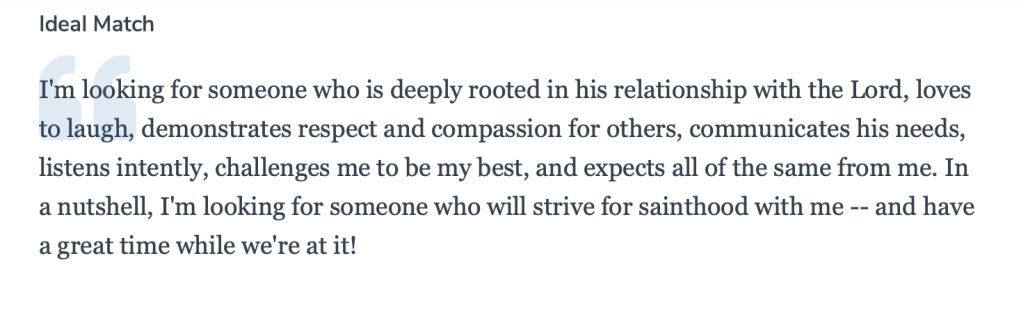
So would I recommend Catholic Match? Probably. Was it worth the investment? Without a doubt. As I joked to our priest in marriage prep, Mr. Pink Tie was the “best $29.99 I ever spent.” He truly is the “ideal match” I described in my profile — and so much more. But whether or not things work out the way we want or plan, we can always, always, always trust in the Lord.

Praise God from whom all blessings flow!

In and through the cross: My vocational discernment journey

Then Jesus said to his disciples, “Whoever wishes to come after me must deny himself, take up his cross, and follow me. For whoever wishes to save his life will lose it, but whoever loses his life for my sake will find it.

--Matthew 16: 24-25

“What is your vocation?”

My friend and fellow women’s group leader posed this question to all of us one warm Tuesday evening earlier this summer. We were wrapping up an 8-week series on the “feminine genius” as conceptualized by Catholic thinkers like St. John Paul II and St. Edith Stein, and our final session was focused on our mission and vocation as women.

Her question caused our otherwise chatty group to fall silent, as everyone shifted uncomfortably and avoided eye contact. It’s no wonder — at the time, all but one of us were unmarried, and none of us were actively discerning religious life, which left only the vocational “gray areas” of either dating or being single and ready for a Pringle (I think this is how the Catechism puts it). Could we claim to know our vocations this early on, when so much was still up in the air?

For my non-Catholic readers, you might be wondering what all the fuss is about, or what I even mean by “vocation.” Vocation literally means “calling,” and the Catholic Church uses the term to refer to several different types of callings. In the broadest sense, we all have the universal vocation to love — the very purpose for which we were created. In a more narrow sense, we each have a calling to a specific way of using our time and talents — perhaps as a teacher, a nurse, or a marine biologist. But the most common way we talk about vocation is in reference to one’s calling to a particular state in life: either marriage, the priesthood/religious life, or consecrated singleness.

Vocation is SUCH a hot topic in Catholic young adult circles, and if you haven’t “figured it all out” by your early to mid-twenties, the pressure to do so seems to grow exponentially with each passing year. It’s not simply that we see our peers getting married or joining a convent and experience FOMO — it’s that as Catholics, we believe that our vocation is the primary means through which God will help us to grow in virtue and holiness so we can spend eternity with Him in heaven. Thus, it’s easy to fall into the trap of thinking that our life doesn’t truly “begin” until we’ve started living out our vocation.

And for those who feel called to marriage but simply haven’t found the right person yet, this waiting game can be particularly excruciating. We all know how hard it is to navigate dating and find a life partner in today’s world in general — imagine wanting that partner to be a faithful Catholic who attends mass regularly, has a strong prayer life, and embraces even the most difficult-to-grasp teachings of the Church. I can’t speak for the men out there, but as a Catholic woman, the dating pool often feels more like a puddle (amirite, ladies?). To help illustrate, I created this highly sophisticated infographic:

Image 1. The Catholic Dating Puddle. Source: Years of searching and many nights spent lamenting with female friends over the state of the Catholic dating world.

So as we all sat there, trying to figure out how to answer this most basic and yet exceedingly difficult question, I finally broke the silence.

“I’m going to go out on a limb and say that my vocation is marriage, even if I never actually end up married.”

The other girls looked intrigued. I went on to explain an experience from the year before, when, as any sensible Catholic woman who has recently experienced a painful breakup might do, I decided to look into this whole “vocational discernment” thing once and for all.

Ever since my conversion to Catholicism, I had mostly assumed that my vocation was marriage. I had dated pretty consistently and hadn’t experienced any real pulls toward consecrated or religious life, so I hadn’t given it too much additional thought. Moreover, I knew that for an introverted homebody like myself, it would be way too easy to “discern” that my vocation was to become a cloistered nun and never interact with the outside world again. (Catholic writer, comedian, and podcast host Jen Fulwiler has often joked about missing a calling to become a desert hermit, and boy is that the most relatable thing anyone’s ever said.)

But during the summer of 2020, after the end of a seemingly promising relationship, I decided it was time to double-check these assumptions. I started by signing up for a 3-day virtual retreat designed to help women discern a calling to the consecrated single life. My spiritual director is a consecrated woman, so this vocation was both familiar and intriguing to me. Each day consisted of talks on St. John Paul II’s Theology of the Body and the principles of discernment, a panel discussion featuring women in various stages of consecrated life, and time for personal prayer/adoration. I learned SO much from the experience, but my key takeaways were as follows:

  • Every vocation is a love story. I was amazed by how much each consecrated woman identified as a “romantic” at heart and viewed her discernment process less as a decision and more as a love story — of being completely captivated by Christ and wanting Him to be the sole focus of her life. As a fellow romantic, I found this very encouraging. No matter what, I get to live — and am already living — an epic love story. Cue Taylor Swift!
  • No vocation is inferior to the other. Both married and religious/consecrated women are called to great holiness, even to the “height of mysticism,” as one talk emphasized. As someone who desires a deep interior life, this was a huge relief.
  • The call to consecrated or religious life is marked by a desire to give oneself fully to Christ, not simply a desire for mission. This was a crucial distinction that helped me to realize that much of my interest in consecrated life stemmed from my affinity for the type of work that I saw the women doing in the Church. The retreat reminded me that I can (and should) be involved in mission, formation, and evangelization no matter my vocation.
  • Discernment always involves a choice between 2 or more good things, and it’s important to make this decision in a time of spiritual consolation and not desolation. Thanks to my love of Ignatian spirituality, I was already familiar with this basic principle of discernment — but one of the panel discussions really drove the point home for me. Most, if not all, of the consecrated women shared that they discerned this path while their lives were going well. They had good jobs, and some even had good boyfriends — so consecrated life was truly a calling and not an escape or “last resort.” I realized that whatever I believed my vocation to be, I needed to discern from a place of health and wholeness, not from a place of woundedness after a breakup.

Ironically, the retreat freed me from a lot of fears and misconceptions about both marriage and consecrated life, so I left feeling like I could envision myself in either vocation. But as I continued processing and praying with the information over subsequent weeks, one calling clearly emerged as the one that would fulfill the deepest desires of my heart.

I desired partnership.

When I looked back at my life, I could see how I’ve always longed to be one-half of a dynamic duo, a desire that has manifested in my friendships, my work, and my dating life. More so than being part of a team or group, I cherish the opportunity to work alongside one other person, to balance out each other’s strengths and weaknesses, to get to know each other deeply and become his or her biggest cheerleader and confidante. There have even been times when this yearning was so strong that it prevented me from realizing that I was smack in the middle of a one-sided or otherwise unhealthy partnership.

When I considered this desire in light of my vocation, I realized that perhaps most of all, partnership is not simply how I want to live, but how I want to die. Regardless of which path I take, my vocation is meant to propel me to my ultimate destination — heaven — and this journey can only be completed in and through the cross. Whether I get married or join a convent, I will have to die to myself every single day, in ways both big and small. This doesn’t mean that my vocation won’t also bring me immense peace and joy — it’s a both-and, not an either-or. I will find joy from self-gift and self-denial. I will find peace from surrendering every part of my life to God. And if I got married, I would be walking this path alongside someone who has vowed to do the same for me. This, my friends, is how I want to die.

So I explained this to my women’s group, and I concluded by acknowledging that feeling called to marriage didn’t guarantee that I would actually get married. (See my post, “The truth about singleness: Trading tired cliches for real talk (From a fellow single gal),” for a full-length rant/exposition on this topic.) However, in the weeks and months after the retreat, I still felt strongly that pursuing this path and being open to dating was exactly where the Lord was calling me. And even if never found someone, I knew that He would work through all those years of growing in trust and patience and surrender, and He would fulfill my desire for partnership in other beautiful ways.

So this is where my heart was at the end of summer 2020, when a horrific car accident produced unexpected healing and a hilarious mishap launched me into the world of online dating. This is where my heart was when my Coffee Meets Bagel experience led me to reluctantly set up a Catholic Match profile. This is where my heart was when — well, I’ll save that for my next post, when I share part 3 of my online dating story.

Feel your feelings: Allowing conflicting emotions to co-exist

After withdrawing about a stone’s throw from them and kneeling, he prayed, saying, “Father, if you are willing, take this cup away from me; still, not my will but yours be done.” And to strengthen him an angel from heaven appeared to him. He was in such agony and he prayed so fervently that his sweat became like drops of blood falling on the ground.
-- Luke 22: 41-44

I didn’t want to cry.

But standing there in my dark kitchen, shivering despite the numerous blankets and layers of clothing in which I was bundled, preparing to boil the little bit of water we’d rationed so I could wash just the most essential dishes, I finally let the tears flow freely.

It was Ash Wednesday, and oh, what a start to Lent 2021 it was. The weekend prior, Winter Storm Uri had caused temperatures to plunge across Texas, wreaking snowy, icy havoc everywhere she went. It should be noted that as a Midwesterner, I’m no stranger to winter weather — I’ve waited for the school bus in a negative 11 degree windchill and we just called it a Tuesday, y’all. And although living in Texas for the past 4 years has certainly diminished my tolerance to extreme cold, I still sleep in shorts and a t-shirt year-round (usually with my ceiling fan on) and consider anything above 50 degrees “springtime” and above 70 degrees “bathing suit weather.” But the devastating effects of this storm went far beyond making a few warm-blooded Texans shiver. Uri tested the limits of our state’s power grid, public water systems, and general emergency preparedness like never before, and the test results weren’t good.

In Houston, for example, everything from the architecture of our homes to the makeup of our energy delivery systems is designed to withstand the weather that we typically experience: brutal heat that extends well into October, humidity second only to an actual rainforest (subtropical climates for the win, yo), and…Hurricane Season (cue horror-movie-style scream). Uri brought the coldest temperatures the city has seen in decades, including Houston’s first-ever wind chill warning, and our infrastructure couldn’t handle the truth.

When the power first went out at my house on Monday morning, my roommates and I snapped into action. (Well, right after posting the obligatory “Texas snow day” pics to the ‘Gram, of course.) We dug out all the candles, flashlights, and portable phone chargers we could find and walked to the corner gas station to buy ice for our coolers. We pushed our living room couches together, piled them high with blankets and pillows, and huddled together playing cards and reading books to pass the time. When we heard that we were likely to lose some or all water pressure, we began filling bowls and jugs with the precious resource.

We did pretty well for those first two days. But by mid-week, when the temperature inside the house had reached 44 degrees, the toilets had stopped flushing, and we no longer had any water in the kitchen, the situation was getting more and more difficult to bear. To make matters worse, there was no clear end in sight, since by that point, power companies had abandoned any attempts to provide estimates regarding when to expect service to return. My can-do attitude was waning, to say the least. So that Ash Wednesday morning, as I waited for the water to boil for dishes, I pulled up my Spotify app and hit “play” on my Lenten playlist. In that moment, I needed something to lift my mind and heart even more than I needed to preserve the battery life on my phone.

As music filled the air and hot tears flowed down my icy cheeks, I began to pray:

Lord, show me your abundance.

I knew it was somewhere; I was just struggling to find it, to excavate it from all the dirt and rubble of this experience. Mentally, it was also getting difficult to focus on anything other than how desperately I craved a hot shower. But I kept trying.

Lord, show me your abundance.

As I set the last clean dish on the drying rack, I paused and looked around. I saw the flickering candles scattered across the kitchen island and was grateful for the source of light on this dark morning. I saw the coolers lined up against the walls and was grateful we had been able to salvage so much of the food in the fridge. I saw the gas stove and was grateful that we could still cook and boil water without electricity. I saw the couch bed piled high with blankets, books, and Trader Joe’s chocolates and was grateful that I had such caring and resourceful roommates. I saw the mug of pour-over coffee I had managed to rig up with just a mesh strainer, a paper filter, and a dream, and I was grateful that even in such crazy times as this, I still had my favorite beverage — and more importantly, that no one had to endure the natural disaster that is Paige Without Caffeine.

And even with all this genuine thanksgiving, I still felt the weight of the suffering that all of us were experiencing. I still felt a tinge of anger that after all we’d been through — from Hurricane Harvey to the pandemic — Texas was having to withstand yet another blow. I still felt the ripple of fear — almost as chilling as the wind outside — from not knowing when this would all be over, or what the long-term effects would be. And as I stood there, feeling like Ron Burgundy in a Glass Case of Emotion, I was grateful for a faith that not only allows for both joy and sorrow, but that allows these experiences to co-exist. I didn’t have to choose whether to be happy or sad, content or frustrated, hopeful or scared. I could be all of these things at once, and bring them all to the Lord, who Himself became man and, in doing so, experienced the full range of human emotions.

Some of my favorite gospel passages are those in which we see Christ allowing Himself to “feel His feelings,” as my therapist might say. When Jesus enters the temple in Jerusalem and sees that a house of worship has been made into a marketplace, he doesn’t just drop a complaint in the Suggestion Box and go on his way. Instead, he “overturn[s] the tables of the money changers and the seats of those who were selling doves” and condemns the people for allowing a sacred space to become a “den of thieves” (Mark 11:15-17). There’s such a thing as righteous anger, y’all! And after the death of Lazarus, a man whom Christ considered a beloved friend, Jesus flat-out weeps (John 11:35) — even though His next move will be to raise Lazarus from the dead. He knows that Lazarus will soon be with them again, and He knows that He can bring a greater good out of the situation, and yet — He is still moved to tears when He witnesses the mourning of Lazarus’ sisters and community. And He doesn’t try to talk Himself, or anyone else, out of it with affirmations or false positivity. He lets the dang tears flow.

And then we have the Garden of Gethsemane, where Jesus experiences the weight of all the sins of the world, as well as the dreaded anticipation of what He knows is coming on Good Friday, and utters a most shocking and beautiful prayer: “Father, if you are willing, take this cup away from me; still, not my will but yours be done” (Luke 22:42). Whenever I am tempted to think that God can’t possibly understand my problems, I am reminded that Jesus’ distress the night before His crucifixion was so great that he was literally sweating blood. I have cried to the point of a corneal abrasion, but geez, I have never been that overcome. Our Lord gets it. He really does. And yet, He shows us how to feel our feelings while still remaining perfectly obedient to the will of the Father. Thanks to Christ’s example, we can pray, “Father, this is what I’m going though, and I sincerely wish it weren’t so. Yet, I know you can and will bring good out of this terrible situation, so I trust in your providence, even when I don’t fully understand the how or why.”

And it goes both ways: Just as our faith helps us to find goodness and abundance when things feel dark, it allows us space for sorrow even when things are bright. We are now in the Easter season, a time of hope, renewal, and resurrection — but that doesn’t mean life is suddenly going to be all sunshine and rainbows and Cadbury cream eggs. We’re still living amidst a global pandemic, our society is still plagued by systemic racism, and we all continue to experience our own personal trials and tribulations. We can allow ourselves to feel the weight of these struggles even as we celebrate the joy of Easter and remember that Christ came into this messy world to redeem it. It’s the “both-and” nature of our faith, and it’s one of my favorite parts of being Catholic.

So friends, whatever you’re going through this Easter season, I hope you allow yourselves to feel your feelings, and that in doing so, you experience greater union with the life, death, and resurrection of our Lord, who Himself experienced the good, the bad, and unimaginably ugly — all for love of you.

The litany of letting go: A prayer for control freaks & perfectionists

The LORD will fight for you; you have only to keep still.
-- Exodus 14:14

In early February, I attended a weekend-long silent prayer retreat in Dickinson, Texas.

For an introvert like me, silent retreats are a DREAM, y’all. And this one came at just the right time. I realized that in the six months since I moved back to Houston, I hadn’t taken time to truly slow down and rest. Between starting a demanding new job, reuniting with all my friends, co-leading a women’s group, and getting back into the dating game, my days have been full to the brim. I wouldn’t trade any of it for the world, but a girl’s still gotta rest, yo.

I do my best to go into retreats without too much of an agenda so that I can let the Lord do what He wants to do; however, I like to have an overarching theme, quote, or scripture verse to help guide my experience. During the week leading up to the retreat, I wasn’t feeling particularly inspired — until one day, I walked into the kitchen while one of my roommates was listening to The Bible in a Year podcast hosted by Fr. Mike Schmitz. If you’re at all familiar with Fr. Mike, you know that he is incredibly skilled at packing truth and wisdom into bite-sized clips, thanks to both his snappy insights and lightning-fast speech. So it was not surprising that although I was in the kitchen for all of sixty seconds, I managed to gain all the clarity I needed.

Fr. Mike was discussing a passage from Exodus chapter 14, and when he got to verse 14, I was nearly stopped in my tracks:

“The Lord will fight for you; you have only to keep still.”

My type A, perfectionist, control freak, over-scheduled, exhausted heart breathed a sigh of relief, and I knew right away that this would be my guiding verse for the retreat. Just the thought of rest put me more at ease. I jotted the verse in my journal (as well as on a Post-It note affixed to my computer monitor for good measure), and for the remainder of the week, every time I saw it, I felt a little surge of excitement and anticipation for what this retreat might have in store.

When I arrived at the retreat center on Friday evening after a long workweek and 90 minutes of battling Houston rush hour traffic, I wondered if I’d ever be able to slow down enough to actually pray — or even sleep, for that matter. And as I greeted numerous friends and acquaintances in the check-in line, I found myself wishing that we could all just hang out and catch up instead of doing this hard thing we were about to do. But over the next few hours, as we turned off our phones and entered into silence, the hustle and overstimulation of everyday life began to drift away on the evening breeze. My racing mind slowed to a walk (or at least a jog), and my tense muscles began to feel relaxed and heavy. By the time we said our night prayers around 9 pm, I could hardly keep my eyelids open. When I arrived at my room, I crawled right into bed and — without text messages, social media feeds, or Brooklyn 99 on Hulu to distract me — fell almost immediately into a sleep so deep it might be medically classified as a coma. When I woke up naturally NINE HOURS LATER, I honestly felt like a different person, and I wasn’t sure what day or even what year it was. (After all, the last time I had slept for nine consecutive hours was last summer, when I was recovering from my wreck and sleeping off a mild concussion.) As I sipped some coffee and cracked open my journal, relishing this newfound surge of energy, clarity, and creativity, I was suddenly and inexplicably reminded of The Dream.

The Dream was an inspiration that came to me several years ago. It started as a long-term career trajectory and gradually came to encompass so much more. The Dream outlined a path for how my work, vocation, and ministry could all come together, and it beautifully integrated a number of my seemingly unrelated interests, skills, and experiences. But despite my initial excitement about The Dream, I had all but forgotten it over the past few years, as other concerns and commitments took precedence and as the busyness of everyday life made such a huge undertaking seem nearly impossible. But now, armed with a good night’s sleep, a few hours of unscheduled time, and some caffeine, The Dream felt a little more within reach. I began to furiously jot ideas in my journal, filling page after page until it was time for breakfast and our first session of the day.

The rest of the weekend was a beautiful blur of silent prayer punctuated by activities such as mass, confession, adoration, talks, and even opportunities for spiritual direction (all with COVID-19 protocols in place, of course). There were times I felt very close to God and times I felt bored, distracted, or just plain stuck. There were times when I prayed intensely and times when I simply took a walk or a nap. (Yes, I took not one but TWO naps on Saturday, despite the aforementioned 9-hour coma.) I could go on for days about the interior journey that took place in the 2.5 days of the retreat, but to make a long story short, the more I entered into a silent, restful state, the more it became abundantly clear that if I ever hoped to achieve The Dream — or any dream, for that matter — something needed to change.

My first thought was that I couldn’t maintain my current pace of life, but as I dug deeper, I realized that the problem had less to do with how much I had going on and more to do with how much I expected of myself in each of those areas, as well as my tendency to conflate all tasks as equally important and urgent. It wasn’t that I had to choose between my work, my spiritual life, my relationships, my ministry commitments, my hobbies, and my health — it was that I needed to better prioritize these areas and respect my limitations as a human and not a Lean, Green, Productivity Machine. This is, of course, not a new struggle — this is the Story of My Life (cue One Direction) and the motivation behind starting this blog. But in that moment, with The Dream tugging on my heart, it had never been so clear to me that my perfectionism was truly going to be an obstacle to my progress rather than a catalyst for it.

I think part of me has always assumed that my perfectionism is one of my secret weapons, that sure, it can be annoying, but just look at the results it produces! A home and car that are always tidy, an inbox that’s always empty, an up-to-date spreadsheet for every facet of life, a flawlessly prepared agenda for my women’s group, error-free deliverables for every work assignment, a menu plan of healthy meals every week, laundry that’s never overdue — and the list goes on. But at what cost? These weren’t the only outcomes of a perfectionist lifestyle. There were also the therapy visits, sleepless nights, anxiety meds, silent tears, tension headaches, and constant reminders from my ruthless inner critic that everyone else had these things figured out and I, somehow, was terribly behind and inadequate. I wasn’t just making the perfect the enemy of the good — I was making it the enemy of my health, happiness, and ability to achieve what’s truly important to me.

When I explained this emerging dilemma to my spiritual director late Saturday afternoon, she surprised me with her response.

“I think you’re ready to make a complete act of surrender to the Lord,” she said calmly.

Say whaaaaat?

At first I wasn’t entirely sure how this tied into my struggle with perfectionism, or what an act of surrender was even supposed to look like. But I’ve worked with my spiritual director for nearly 3.5 years now, and she has never led me astray, so I took her advice to heart. I once again opened my journal, this time with the goal of verbalizing the specific fears, temptations, and situations that present the greatest obstacles to loosening my grip and relinquishing control. And as I did, I began to see precisely why my spiritual director had given me this suggestion. The end result, after several weeks of revising and editing, was the prayer below.

I call it the “Litany of Letting Go” (cue Elsa), partly because the “Litany of Surrender” was already taken and partly because to me, this phrasing simply resonates more deeply. At first this prayer felt extremely personal, but after talking about it with several friends, I realized that perhaps it would be helpful to share. I know SO many people who can relate to one or more aspects and who, like me, are seeking deliverance from these struggles.

In a future post, I’ll share more about the concrete ways I’ve seen my thoughts, words, and actions change as a result of praying this powerful petition nearly every day. But for now, I offer it to you, my readers, in hopes that you’ll try it, tweak it, and truly make it your own — and of course, let me know how it goes. I’ve even divided it into sections so you can pick and choose what resonates most. Now get out there and “Let It Go”!

The Litany of Letting Go

PRIDE + CONTROL
From the belief that I have to “do it all”…
From the fear that if I don’t do it, no one will…
From the belief that my way is the best or only way…
From the temptation to give unsolicited feedback, advice, or correction…
From resistance to accepting the help or ideas of others…
From the tendency to seek inner peace by controlling my outward environment…
Deliver me, Jesus.

BUSYNESS + STRIVING
From the constant urge to be “productive,” even if it means filling my time with unimportant tasks…
From the desire to “keep up’” with those around me…
From the view of busyness as a status symbol…
From the belief that I have to earn rest or wait until I’m completely exhausted to pause…
From all unnecessary pressure or “shoulds”…
Deliver me, Jesus.

PLANNING + PREPARATION
From the insatiable desire to always know what’s coming…
From the fear that if I don’t perfectly plan or prepare, I will endure needless suffering…
From the belief that my plans are better than Yours…
From any suspicion or skepticism of Your infinite love and care for me…
Deliver me, Jesus.

SELF IMAGE + SELF-TALK
From my ruthless inner critic…
From impossible or unreasonable expectations of myself and others…
From the belief that I am lazy or inadequate if I lower or adjust my standards…
From the temptation to equate my work/productivity with my worth…
From false ideas about who I am or who You are…
Deliver me, Jesus.

PEOPLE PLEASING
From the fear of what others will think of me when I am true to myself and to Your call for me…
From the tendency to care more about what others think of me than than what You think of me…
From the desire for affirmation…
From the fear of asking for what I need…
From the fear of setting and maintaining healthy boundaries…
From the fear of letting others down…
From the fear of letting others see my mess...
Deliver me, Jesus.

RESTLESSNESS
From all forms of restlessness…
From any false sense of urgency…
From my love of comfort and fear of the cross…
From the desire to “earn” Your love rather than receive it unconditionally…
From undue attachment to anything other than You…
From fear of what will happen when I surrender all to You...
Deliver me, Jesus.

Jesus, I love You. Help me to love You more. 
Jesus, I trust You. Help me to trust You more.
Jesus, I surrender to You. Help me to surrender more.

Amen.